Using the Korea Microlensing Telescope Network (KMTNet), an international team of researchers has discovered that super-Earth exoplanets are more common across the Universe than previously thought.
By studying light anomalies made by the newly found planet’s host star and combining their results with a larger sample from a KMTNet microlensing survey, the team found that super-Earths can exist as far from their host star as our gas giants are from the Sun.
Andrew Gould, co-author of the study and professor emeritus of astronomy at The Ohio State University, said: “Scientists knew there were more small planets than big planets, but in this study, we were able to show that within this overall pattern, there are excesses and deficits.”
How microlensing helps detect super-Earth exoplanets
While it can be relatively easy to locate worlds that orbit close to their star, planets with wider orbits can be difficult to detect.
Still, researchers further estimated that for every three stars, there should be at least one super-Earth exoplanet present with a Jupiter-like orbital period. This suggests that these massive worlds are extremely prevalent across the Universe.
The findings in this study were made via microlensing, an observational effect that occurs when the presence of mass warps the fabric of space-time to a detectable degree.
When a foreground object, such as a star or planet, passes between an observer and a more distant star, light is curved from the source, causing an apparent increase in the object’s brightness that can last anywhere from a few hours to several months.
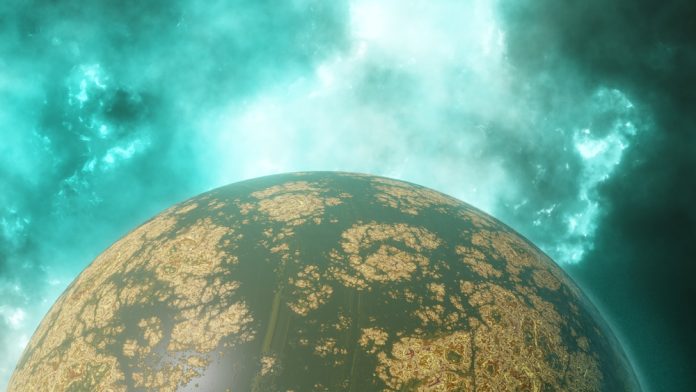
Astronomers can use these fluctuations, or bumps, in brightness to help locate alien worlds unlike our own. In this case, microlensing signals were used to locate OGLE-2016-BLG-0007, a super-Earth exoplanet with a mass ratio roughly double that of Earth’s and an orbit wider than Saturn’s.
These observations allowed the team to divide exoplanets into two groups, one that consists of super-Earths and Neptune-like planets, and the other comprising gas giants like Jupiter or Saturn.
This discovery opens new doors for planetary system science. Having a better understanding of exoplanet distribution can reveal new insights about the processes by which they form and evolve.
Mechanisms for producing exoplanets vary
To explain their results, researchers also compared their findings to predictions made from theoretical simulations of planet formation.
Their results showed that while super-Earth exoplanets can be separated into groups by mass and makeup, the mechanisms that may produce them can vary.
“The dominant theory of gas-giant formation is through runaway gas accretion, but other people have said that it could be both accretion and gravitational instability,” said Gould. “We’re saying we can’t distinguish between those two yet.”
Richard Pogge, another co-author of the study and a professor of astronomy at Ohio State, explained: “Finding a microlensing star event is hard. Finding a microlensing star with a planet is hard-squared.
“We have to look at hundreds of millions of stars to find even a hundred of these things.”
Reconstructing the Universe’s history with the KMTCam
These alignments are so rare that only 237 out of the more than 5,000 super-Earth exoplanets ever discovered have been identified using the microlensing method.
Now, with the help of three powerful custom-built telescopes located in South Africa, Chile, and Australia, the KMTNet system routinely allows scientists to scour the cosmos for these amazing events.
As the technology continues to evolve, having dedicated, global collaborations like this one will turn visions of scientific theory into real discoveries.
Pogge concluded: “We’re like palaeontologists reconstructing not only the history of the Universe we live in but the processes that govern it.
“So helping to bring both of those pieces together into one picture has been enormously satisfying.”