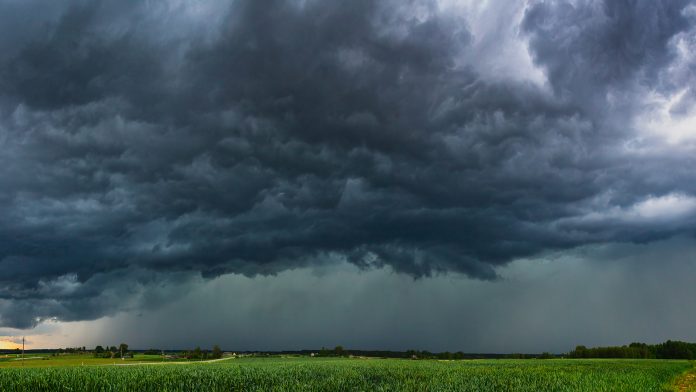
Global Navigation Satellite System (GNSS) observations of tropospheric water vapour support weather forecasts and tracking of severe weather events at many national and international meteorological services.
Global Navigation Satellite Systems have become ubiquitous in modern technology and data-driven societies and support many more applications beyond positioning, navigation, and timing (PNT) activities.
The role of GNSS in weather forecasting
As the GNSS signals travel from their mostly mid-Earth-orbiting (MEO) satellite transmitters to the receivers either on low-Earth-orbiting (LEO) satellites or terrestrial tracking stations, they experience various atmospheric effects. Tropospheric signal delays are among the most significant contributors to positioning errors in GNSS, exerting a crucial influence on accuracy once orbital and satellite and receiver clock uncertainties have been addressed.
When GNSS signals travel through the troposphere, roughly the lowest 15km of the atmosphere, they encounter varying levels of water vapour, temperature, and pressure that slow and bend their paths. This effect is typically decomposed into two components: a relatively stable hydrostatic delay linked to atmospheric pressure, and a highly variable wet delay driven by water vapour.
Advanced GNSS processing strategies rely on mapping functions to project these delays experienced in the line-of-sight between receiver and satellite into zenith delays, while stochastic models estimate wet delay fluctuations and horizontal gradients. By separating these terms and carefully tuning random walk or similar constraints, GNSS analyses can capture both gradual and rapid changes of water vapour in the atmosphere.
As atmospheric water vapour is the dominant natural Greenhouse gas, it is a key parameter for studying climatic changes, but as it is also a determining factor for weather, precipitation in particular, water vapour estimates from GNSS play a key role in modern weather forecasting. GNSS-derived atmospheric products, such as Zenith Total Delay or Precipitable Water Vapour estimates, help pinpoint the time and location of precipitation when assimilated into numerical weather prediction (NWP) models. This leads to meteorologists being better able to anticipate storms, tropical cyclone behaviour, or heavy rainfall, and ultimately refine severe weather warnings. Because water vapour plays a direct role in precipitation processes, timely GNSS-derived atmospheric products often lead to more accurate rainfall predictions, local wind forecasts, and storm timings. Moreover, with densely distributed GNSS networks it becomes possible to enable tomography-like methods, producing three-dimensional reconstructions of water vapour fields. These are particularly interesting for studying some of the physical processes in storms.
Applications in climate research and long-term monitoring
Beyond operational meteorology, Global Navigation Satellite Systems play an increasingly important role in climate research. Long-term records of tropospheric delays provide high-resolution datasets that capture gradual shifts in moisture distribution, informing studies of extreme precipitation, changes in cloud cover, temperature, and moisture feedbacks. These records are especially valuable as they offer continuous, round-the-clock observations, complementing other observation systems such as radiosondes or satellite remote sensing, which may not be as frequent or spatially dense. Recognising the need for such long-term tracking, the Intergovernmental Panel on Climate Change (IPCC) highlights the importance of consistent observations of atmospheric water vapour to understand climate variability and change.
The era of multiple GNSS constellations
By employing the observations from multiple GNSS constellations: GPS, GLONASS, Galileo, BeiDou, QZSS and IRNSS, analysts achieve better spatial coverage and more frequent sampling, improving the resolution of atmospheric estimates. These insights help identify localised phenomena like convective cells or sea breeze fronts that might otherwise be missed by conventional meteorological observations. Moreover, in areas with sparse weather station networks, Global Navigation Satellite Systems add a critical low-cost supplement, boosting our understanding of short-lived weather extremes and long-term climate variations.
Navigating complexity
Despite these advances, tropospheric modelling remains complex due to the dynamic nature of moisture transport and the rapid onset of convective events. Stochastic constraints, such as random walk noise models for wet delay, may not always align with real atmospheric variability, leading to underfitting during sudden moisture surges or overfitting in more stable conditions. Ongoing research is exploring adaptive constraints that shift according to near-real-time meteorological indicators, thereby capturing abrupt gradients more faithfully.
Overall, tropospheric delays remain integral to GNSS accuracy and serve as a gateway to broader atmospheric applications. Continuous improvements in modelling these delays, employing multi-constellation data, and adapting to near-real-time forecasts have driven major strides in meteorological and climate-focused research. High-frequency products benefit users who require quick, precise locations – such as aviation, disaster response, and data assimilation in numerical weather models – while long-term records track how water vapour patterns evolve across seasons, years, and decades. As methods continue to refine tropospheric variability parametrisation, GNSS stands poised to enhance both real-time navigation and the long-term monitoring of Earth’s changing climate.
GNSS meteorology by the GGE
The GGE boasts an established capability in the processing of GNSS observations for the retrieval of atmospheric water vapour for operational assimilation into NWP models, special studies of severe weather events, and long-term monitoring.
For near-real-time (NRT) applications, i.e., operational assimilation, processing happens within minutes to hours of data capture, placing special emphasis on timeliness and reliability. GNSS data can be collected from regional to global station networks in minutes and then processed, providing updated solutions every 30 or 60 minutes with five to 15 minutes delay estimates.
In fast-moving scenarios like navigation for ground or airborne vehicles, but also storm tracking, the GNSS-derived atmospheric products may be updated at high frequency in real-time, i.e., from seconds to a few minutes. Such frequent updates, often used in weather now-casting, are essential because the water vapour distribution, temperature profiles, and local weather patterns can shift drastically, especially during convective storm developments.
For long-term monitoring applications it is the consistency and homogeneity of the coordinate reference frames, GNSS satellite and bias products, and processing strategy and error mitigation modelling that are of highest concern, as any changes in these can make the derived climate record unreliable. To prevent erroneous interpretations, careful homogenisation of these records is needed as with most other climatological data.
The GGE offers:
- GNSS data processing expertise and capabilities for meteorological real-time, near-real-time and long-term atmospheric product retrievals
- Consultancy for atmospheric applications of GNSS in real-time, near-real-time and long-term monitoring
- Consultancy on GNSS ground-station installations and data handling solutions for atmospheric and other monitoring applications
- High-level expertise and capabilities on GNSS-derived product assimilations into numerical weather prediction models, e.g., Weather Research & Forecasting Model (WRF) and WRF Data Assimilation (WRFDA)
- High-level expertise in geodetic and geospatial technologies and associated data analyses, as well as their applications