Scientists have identified what may be the largest black hole ever recorded — a cosmic heavyweight estimated at an astonishing 36 billion times the mass of our Sun.
Found at the heart of the immense ‘Cosmic Horseshoe’ galaxy, this ultra-dense object pushes the boundaries of what astronomers believe is possible.
Using cutting-edge observation techniques, researchers were able to measure its immense gravitational pull with unprecedented precision, offering a rare glimpse into one of the most extreme phenomena known to science.
A monster at the heart of the Cosmic Horseshoe
The black hole sits inside one of the most massive galaxies ever observed.
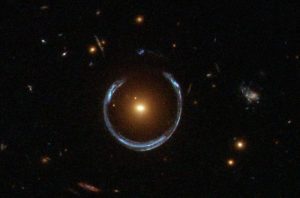
This galaxy is so enormous it bends spacetime, producing a spectacular Einstein ring – a horseshoe-shaped distortion of light from a background galaxy.
The effect not only makes the Cosmic Horseshoe visually striking but also plays a key role in detecting its central black hole.
At roughly 10,000 times the mass of the Milky Way’s central black hole, this object stands near the theoretical upper limit for black hole size. Its sheer scale offers an extraordinary opportunity to study how such titans form and evolve.
A breakthrough in measuring distant black holes
Measuring black holes in distant galaxies has always been a challenge.
Traditional methods involve tracking the motion of nearby stars, known as stellar kinematics, but this technique works best for galaxies relatively close to Earth. At vast distances, those inner regions become impossible to resolve with precision.
To overcome this, researchers combined stellar kinematics with gravitational lensing, where the black hole’s immense gravity bends and magnifies light from objects behind it.
This dual-method approach allowed them to detect subtle changes in both starlight and star motion, confirming the presence and mass of the black hole with unprecedented certainty.
A dormant giant
Interestingly, this potentially largest black hole ever discovered is dormant, meaning it is not actively devouring gas or dust, and it does not emit the bright, high-energy radiation seen in active galactic nuclei or quasars.
Its discovery relied entirely on gravitational effects, making this a rare case where astronomers could precisely measure a silent ultramassive black hole billions of light-years away.
Located about 5 billion light-years from Earth, this colossal black hole shows that even non-active galactic cores can be uncovered and weighed if the right tools and methods are used.
Linking galaxies and black holes
Astronomers believe that the growth of galaxies and their central black holes is closely intertwined. As galaxies expand, material funnels inward, feeding the black hole.
In turn, black holes can influence their host galaxies by releasing enormous energy, often in the form of quasars, which can halt star formation by heating or dispersing gas clouds.
Our own Milky Way houses a relatively modest 4-million-solar-mass black hole. While currently quiet, it may flare into quasar activity in the distant future, particularly when the Milky Way collides with the Andromeda galaxy in about 4.5 billion years.
The fossil group connection
One intriguing detail about the Cosmic Horseshoe is that it belongs to a fossil group – a massive galaxy thought to be the merged remnant of several others.
Over time, all the bright companion galaxies have disappeared, likely absorbed into the central giant. This process could also explain the black hole’s enormous size: multiple supermassive black holes from former galaxies may have merged to form the monster now observed.
In essence, the Cosmic Horseshoe offers a glimpse of the ‘endgame’ of galaxy and black hole evolution – a single, dominant galaxy containing the largest black hole in the Universe.
From dark matter to black hole discovery
The finding was a stroke of luck. Researchers were originally studying the Cosmic Horseshoe to map its dark matter distribution.
While analysing the data, they realised their combined gravitational lensing and stellar dynamics method could also reveal dormant black holes in distant galaxies.
This opens the door to a new era of black hole research. Scientists now plan to use the European Space Agency’s Euclid space telescope to hunt for more examples, which could reshape our understanding of how black holes influence galaxy evolution and star formation.
If confirmed, the Cosmic Horseshoe black hole could stand as the largest black hole ever directly measured.
Its existence challenges astronomers to refine theories about the upper limits of black hole mass and to explore how such giants form, whether through steady growth, galaxy mergers, or a combination of both.