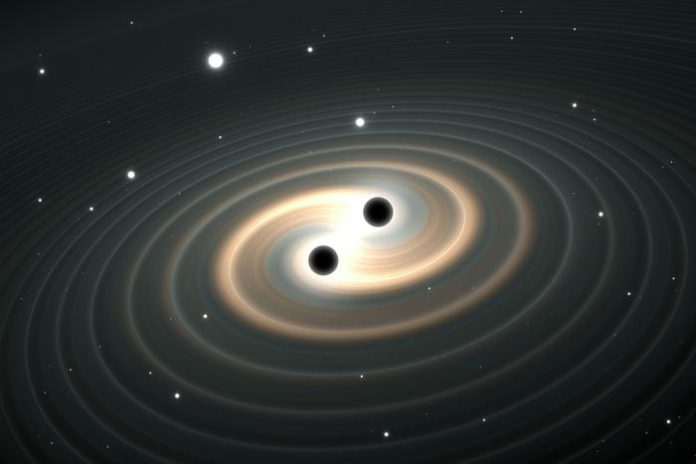
Scientists have unveiled a new approach to detecting gravitational waves in the milli-Hertz frequency range, providing access to astrophysical and cosmological phenomena that are currently undetectable with existing instruments.
Gravitational waves have been observed at high frequencies by ground-based interferometers such as LIGO and Virgo, and at ultra-low frequencies by pulsar timing arrays.
However, the mid-band range has remained a scientific blind spot.
Developed by researchers at the University of Birmingham and the University of Sussex, the new detector concept utilises cutting-edge optical cavity and atomic clock technologies to detect gravitational waves in the elusive milli-Hertz frequency band (10⁻⁵-1 Hz).
Optical resonator technology for atomic clocks
The research reveals a detector that uses advances in optical resonator technology, originally developed for optical atomic clocks, to measure tiny phase shifts in laser light caused by passing gravitational waves.
Unlike large-scale interferometers, these detectors are compact, relatively immune to seismic and Newtonian noise.
“By using technology matured in the context of optical atomic clocks, we can extend the reach of gravitational wave detection into a completely new frequency range with instruments that fit on a laboratory table,” explained Dr Vera Guarrera, from the University of Birmingham, who co-authored the study.
“This opens the exciting possibility of building a global network of such detectors and searching for signals that would otherwise remain hidden for at least another decade.”
Unlocking the milli-Hertz frequency band
The milli-Hertz frequency band – sometimes called the ‘mid-band’ – is expected to host signals from a variety of astrophysical and cosmological sources, including compact binaries of white dwarfs and black hole mergers.
Ambitious space missions such as LISA also target this frequency band, but they are scheduled for launch in the 2030s. The proposed optical resonator detectors can now begin exploring this territory.
Co-author Professor Xavier Calmet, from the University of Sussex, commented: “This detector allows us to test astrophysical models of binary systems in our galaxy, explore the mergers of massive black holes, and even search for stochastic backgrounds from the early Universe.
“With this method, we have the tools to start probing these signals from the ground, opening the path for future space missions.”
Extending gravitational waves to lower frequencies
While future space-based missions, such as LISA, will offer superior sensitivity, their operation is still over a decade away. The proposed optical cavity detectors offer an immediate and cost-effective means to explore the milli-Hz band.
The study also suggests that integrating these detectors with existing clock networks could extend gravitational wave detection to even lower frequencies, complementing high-frequency observatories like LIGO.
Each unit consists of two orthogonal ultra-stable optical cavities and an atomic frequency reference, enabling multi-channel detection of gravitational wave signals.
This configuration not only enhances sensitivity but also allows for the identification of wave polarisation and source direction.