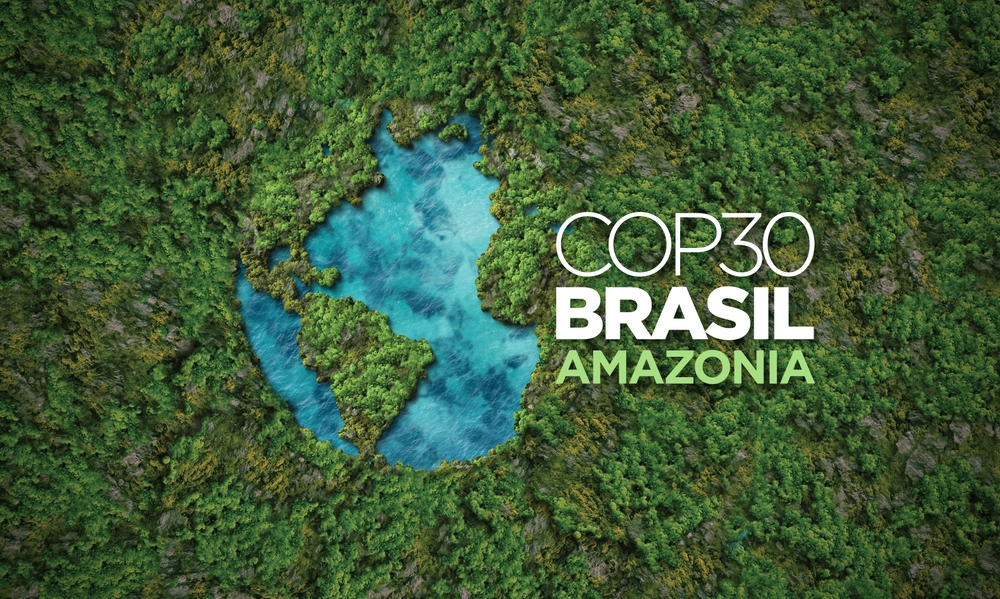
On Thursday and Friday, 6 and 7 November, the capital of the state of Pará will host the COP30 Climate Summit at Parque da Cidade.
The COP30 meeting will bring together heads of state and government, ministers, and leaders of international organisations to discuss pressing climate change challenges and commitments, including forestry and the energy transition.
The themes will be Forests and Oceans on the afternoon of 6 November, Energy Transition on the morning of November 7, and 10 Years of the Paris Agreement, NDCs, and Financing in the afternoon of 7 November.
Preserving the Amazon
Brazil chose the Amazon as the venue for COP30 to highlight the risk that the world’s largest tropical forest could reach a point of no return, leading to irreversible consequences for life on Earth.
Ambassador André Corrêa do Lago emphasised that the Amazon is 75% urban – with cities, communities, and diverse ways of life – and that restoring the forest is not just about halting deforestation, but about generating solutions.
This stance highlights the symbolic and ethical importance of selecting the region to host COP30.
The world and Brazil itself will gain a deeper understanding of the region through the presence of experts, students, and local communities during COP30. “This will change the global perception of what the Amazon is today,” he said.
Efficient fuels are key to the energy transition
Another key agenda at the event will be the energy transition. Leaders are committed to achieving this by 2030, as outlined in COP30, and highlight that ecological transformation plans are underway.
The use of transitional fuels, such as biodiesel, and progress in clean energy were highlighted as key drivers of the energy transition agenda.
This announcement follows the revelation that transport at COP30 will operate on renewable fuel supplied by Petrobras.
A new era of governance for tropical forests
The Tropical Forests Finance Facility (TFFF) will also be a key part of the agenda at COP30.
The TFFF is a financing mechanism in which the World Bank will act as the operator, but the forest-owning countries will define the priorities and rules.
The mechanism will allocate a portion of its resources directly to Indigenous peoples and traditional communities, ensuring that these groups play a leading role. According to its creators, the initiative represents “a new paradigm of governance for tropical forests.”
Environment and Climate Change Minister Marina Silva stated: “This is a framework born within the Ministry of Environment, with support from the Ministry of Finance and the Ministry of Foreign Affairs, and it already has initial contributions from Brazil and Indonesia.
“The TFFF will allocate 20% of its resources directly to Indigenous peoples and local communities.”
World’s top leaders show commitment to tackling climate issues
For Ambassador Liliam Chagas, Director of the Climate Department at the MRE and Brazil’s negotiator at COP30, holding the summit in Belém reflects Brazil’s decision to give a strong political profile to the issue of climate change.
“The world collectively needs to reverse this trend of rising temperatures. We already have a vast body of rules, norms, tools, and mechanisms to help countries reduce emissions and adapt to climate change,” she said.