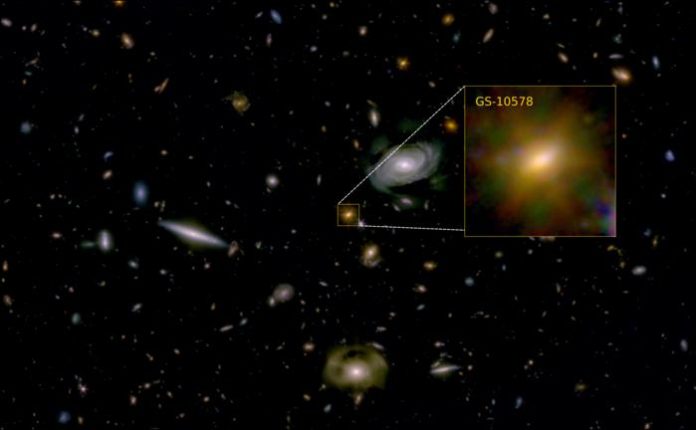
University of Cambridge astronomers have identified one of the earliest known dead galaxies, shedding new light on how some massive galaxies in the young Universe abruptly stop forming stars.
Using observations from the James Webb Space Telescope (JWST) and the Atacama Large Millimeter Array (ALMA), researchers found that a growing supermassive black hole can slowly starve a galaxy rather than destroy it outright.
A massive galaxy from the early Universe
The galaxy, catalogued as GS-10578 and nicknamed Pablo’s Galaxy, existed just three billion years after the Big Bang.
Despite this early stage in cosmic history, it is enormous – around 200 billion times the mass of the Sun. Most of its stars formed between 12.5 and 11.5 billion years ago, indicating a rapid burst of star formation before the galaxy suddenly shut down.
Dubbed a “live fast, die young” galaxy, Pablo’s Galaxy stopped producing stars while still relatively young. The culprit appears to be a severe shortage of cold gas, the essential ingredient for star formation.
Starvation rather than destruction
Rather than a single catastrophic event, researchers found evidence of gradual suppression. The galaxy’s central supermassive black hole repeatedly heated surrounding gas, preventing it from replenishing the galaxy.
Over time, this process effectively strangled star formation – a phenomenon the team described as “death by a thousand cuts.”
ALMA observations aimed to detect carbon monoxide, a tracer of cold hydrogen gas, but after nearly seven hours of observation, astronomers found almost none.
The absence of gas itself provided critical insight, demonstrating that the galaxy’s shutdown was caused by slow starvation rather than a violent blowout.
JWST spectroscopy further revealed powerful winds of neutral gas streaming from the black hole at 400 kilometres per second.
These outflows remove roughly 60 solar masses of gas annually, potentially depleting the galaxy’s remaining fuel in as little as 16 to 220 million years – far faster than the billion-year timescale typical for other galaxies.
A calm but deadly process
Despite these extreme conditions, Pablo’s Galaxy maintains a calm, rotating disc structure, indicating it avoided major mergers or disruptive collisions.
Star formation ceased around 400 million years ago, long before the current black hole activity. This pattern suggests that repeated cycles of heating and gas expulsion prevented fresh fuel from entering the galaxy, rather than any single dramatic event.
By reconstructing the galaxy’s star-formation history, researchers concluded that the system evolved with net-zero inflow: new gas never refilled the galaxy. The black hole’s repeated interventions effectively kept the galaxy from regenerating its star-forming material.
Implications for early galaxy evolution
The discovery of this dead galaxy helps explain the increasing number of massive, unexpectedly mature galaxies detected by JWST in the early Universe.
These galaxies had puzzled astronomers, appearing older and more evolved than models predicted. Slow starvation by supermassive black holes now offers a compelling explanation for their rapid ageing.
The study also underscores the power of combining ALMA’s ultra-deep radio observations with JWST’s infrared spectroscopy.
By analysing both cold and warm gas, astronomers can gain a more complete picture of how black holes influence galaxy evolution.
Future observations
The Cambridge team has secured an additional 6.5 hours of JWST observation time using the MIRI instrument.
These new measurements will focus on warmer hydrogen gas, helping scientists understand precisely how supermassive black holes starve galaxies like Pablo’s Galaxy.
Researchers hope that studying more early dead galaxies will reveal whether slow starvation is the dominant mechanism shutting down star formation across the early Universe.