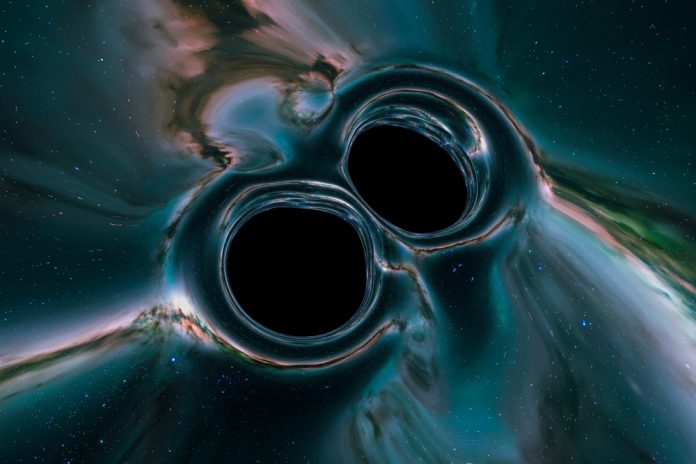
In a major leap for astrophysics, the international LIGO-Virgo-KAGRA Collaboration has announced the detection of two extraordinary black hole merger events, each revealing rare and puzzling spin characteristics.
Detected in October and November 2024, these cosmic collisions have given scientists fresh insights into how some of the Universe’s most extreme objects form and evolve – and have even allowed researchers to test Einstein’s general theory of relativity with unprecedented precision.
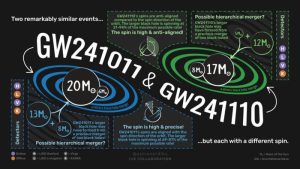
The two newly reported black hole merger events, named GW241011 and GW241110, were detected just a month apart yet exhibit dramatically different characteristics.
Both, however, challenge what scientists thought they knew about black holes and hint that some of these cosmic giants may be ‘second-generation’ black holes born from earlier mergers.
The first signal: A rapidly spinning black hole
The first black hole merger event, GW241011, rippled through spacetime on 11 October 2024, travelling nearly 700 million light-years before reaching Earth. It resulted from the collision of two black holes about 17 and seven times the mass of our Sun.
What made GW241011 stand out was the incredible spin of its larger black hole — one of the fastest ever observed. This rotation provided scientists with a rare opportunity to examine the fine details of spacetime distortion.
Using advanced algorithms and waveform modelling, researchers confirmed that the event aligned perfectly with Einstein’s predictions for rotating black holes, first described mathematically by Roy Kerr in the 1960s.
The signal even contained higher ‘harmonic’ frequencies – overtones similar to those in musical instruments – marking only the third time such features have ever been detected.
These harmonics offered another successful test of general relativity, showing how gravitational waves encode subtle information about black hole structure.
The second event: A spin in reverse
Just four weeks later, on 10 November 2024, LIGO, Virgo, and KAGRA detectors captured a second event – GW241110 – originating a staggering 2.4 billion light-years away.
This black hole merger involved objects roughly 16 and 8 solar masses, but with a shocking twist: the larger black hole was spinning in the opposite direction of its orbit.
Such anti-aligned spins are exceedingly rare and suggest that the system did not form from two stars evolving together but from black holes meeting dynamically in crowded environments like dense star clusters.
This backward spin may therefore be the first clear evidence of hierarchical mergers, where a black hole produced from one collision goes on to merge again – creating a new, heavier generation of black holes.
Signs of ‘second-generation’ black holes
Both events share key traits that point toward this hierarchical merger scenario. Each featured one black hole that was significantly more massive and rapidly spinning than its companion – a pattern that hints at complex histories involving previous collisions.
Astrophysicists believe these systems likely formed in dense cosmic neighbourhoods, such as globular clusters or galactic centres, where repeated gravitational interactions cause black holes to collide multiple times.
In these bustling environments, black holes don’t remain isolated – they merge, spin up, and grow heavier through successive generations.
These findings mark a turning point for black hole research. Out of roughly 300 mergers detected since gravitational-wave astronomy began, GW241011 and GW241110 stand among the most unusual, offering compelling evidence that the Universe’s most violent events may often be recycled collisions.
A triumph for global collaboration
The detections were made possible by the coordinated power of the LIGO observatories in the US, Virgo in Italy, and KAGRA in Japan. Together, they form a global network capable of detecting distortions in spacetime smaller than a proton.
Now nearing the end of its fourth observing run (O4), which began in May 2023, the LIGO-Virgo-KAGRA collaboration continues to push the limits of detection sensitivity.
The team has already identified hundreds of potential black hole mergers awaiting verification, each one offering a new window into the dynamics of gravity, matter, and energy under the most extreme conditions imaginable.
Searching for new particles
The implications of these discoveries reach far beyond astrophysics. Rapidly spinning black holes like those in GW241011 are now being used as natural laboratories to probe the possible existence of ultralight bosons – hypothetical particles that could help explain dark matter and bridge gaps in the Standard Model of particle physics.
If these particles existed, they would gradually siphon energy from spinning black holes, causing their rotation to slow over time. However, the observation that GW241011’s black hole remains an exceptionally fast spinner effectively rules out a wide range of ultralight boson masses.
The future of black hole science
These twin detections signal the beginning of a new era in gravitational-wave astronomy. With each black hole merger observed, scientists are peeling back another layer of the Universe’s most mysterious forces.
The data from GW241011 and GW241110 are helping researchers refine models of how massive stars die, how galaxies evolve, and how gravity behaves under conditions that push Einstein’s equations to their limits.
As the LIGO-Virgo-KAGRA Collaboration prepares for future upgrades and observing runs, astronomers expect to uncover even rarer and more complex events.
Ultimately, every new detection transforms abstract physics into observable reality. The story of the black hole merger is no longer theoretical — it’s an unfolding cosmic narrative that continues to reshape our understanding of space, time, and the origins of the Universe itself.