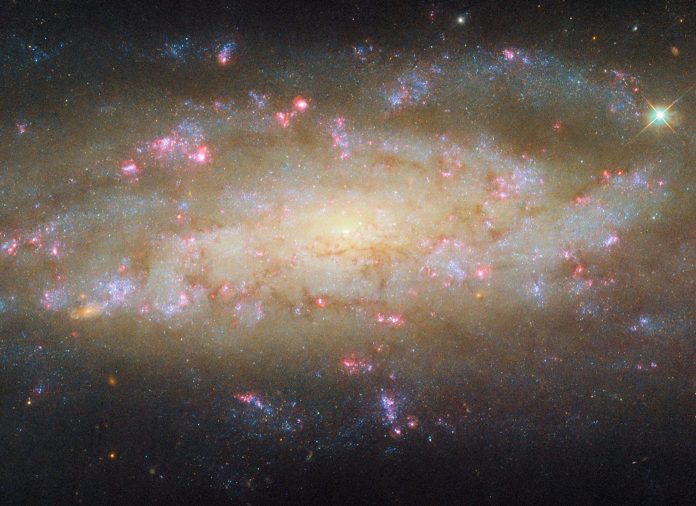
While it may appear as just another spiral galaxy among billions in the Universe, a new image from the NASA/ESA Hubble Space Telescope has revealed that this galaxy has plenty to study.
The spiral galaxy, known as NGC 7456, is located over 51 million light-years away in the constellation Grus (the Crane).
Based on the Hubble image, we can see fine detail in the galaxy’s patchy spiral arms, followed by clumps of dark, obscuring dust. Blossoms of glowing pink are rich reservoirs of gas where new stars are forming, illuminating the clouds around them and causing the gas to emit this tell tale red light.
The Hubble observing programme that collected this data focused on the galaxy’s stellar activity, tracking new stars, clouds of hydrogen, and star clusters to learn how the galaxy evolved through time.
What are spiral galaxies, and what makes them unique?
Spiral galaxies are a type of galaxy characterised by their distinct, spiral-shaped structure. They typically consist of a flat, rotating disk containing stars, gas, and dust, along with a central concentration of older stars known as the bulge.
Spiral arms extend outward from the centre, winding around the galaxy and often appearing brighter due to the presence of young, hot stars and star-forming regions.
What makes spiral galaxies unique is their well-defined spiral structure, which is not commonly found in other galaxy types, such as elliptical or irregular galaxies.
The arms are sites of active star formation, fuelled by the abundance of interstellar gas and dust. This gives these galaxies a bluish hue when viewed in optical light, especially in the arms.
Another distinguishing feature is the presence of a rotating disk, which contributes to the overall flat shape of the galaxy.
Many spiral galaxies, including our own Milky Way, also feature a central bar-shaped structure from which the arms emerge – these are known as barred spiral galaxies.
Spiral galaxies are among the most studied because their structure makes it easier to observe star formation and galactic dynamics.
Their organised, yet dynamic nature offers valuable insights into galaxy evolution and the life cycle of stars.
Discovering X-ray sources from NGC 7456
Hubble, with its ability to capture visible, ultraviolet, and some infrared light, is not the only observatory focused on this unique spiral galaxy.
ESA’s XMM-Newton satellite imaged X-rays from the galaxy on multiple occasions, discovering many so-called ultraluminous X-ray sources. These small, compact objects emit terrifically powerful X-rays, much more than researchers would expect, given their size.
Astronomers are still trying to pin down what powers these extreme objects, and NGC 7456 contributes a few more examples.
Various avenues for astronomers to study
The region around the galaxy’s supermassive black hole is also spectacularly bright and energetic, making NGC 7456 an active galaxy.
Whether observed at its core or its outskirts, at visible light or X-rays, this unique galaxy has something interesting for astronomers to study.