Johns Hopkins researchers may have identified a compelling clue in the ongoing hunt to prove the existence of dark matter.
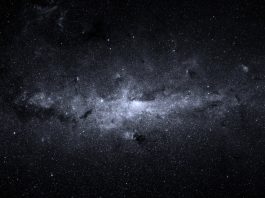
A mysterious diffuse glow of gamma rays near the centre of the Milky Way has stumped researchers for decades, as they’ve tried to work out whether the light comes from colliding particles of dark matter or quickly spinning neutron stars.
According to the new research, it turns out both theories could be equally as likely.
“Dark matter dominates the Universe and holds galaxies together. It’s extremely consequential, and we’re desperately thinking all the time of ideas as to how we could detect it,” said co-author Joseph Silk, a professor of physics and astronomy at Johns Hopkins and a researcher at the Institut d’Astrophysique de Paris and Sorbonne University.
“Gamma rays, and specifically the excess light we’re observing at the centre of our galaxy, could be our first clue.”
Supercomputers can predict where dark matter could be located
The researchers used supercomputers to create maps of where dark matter should be located in the Milky Way, considering the galaxy’s formation history for the first time.
Today, the Milky Way is a relatively closed system, without materials coming in or going out of it. However, this hasn’t always been the case.
During the first billion years, many smaller galaxy-like systems made of dark matter and other materials entered and became the building blocks of the young Milky Way. As dark matter particles gravitated toward the centre of the galaxy and clustered, the number of dark matter collisions increased.
When the researchers factored in more realistic collisions, their simulated maps matched actual gamma-ray maps taken by the Fermi Gamma-ray Space Telescope.
Gamma rays could originate from dark matter
These matching maps round out a triad of evidence that suggests excess gamma rays in the centre of the Milky Way could originate from dark matter.
Gamma rays from dark matter particle collisions would produce the same signal and properties as those observed in the real world; however, the researchers noted that this is not definitive proof.
Light emitted from reinvigorated, old neutron stars that spin quickly – called millisecond pulsars – could also explain the existing gamma ray map, measurements and signal signature.
However, the researchers noted that this millisecond pulsar theory is imperfect. To make those calculations work, researchers have to assume there are more millisecond pulsars in existence than they’ve observed.
New telescope could provide definitive answers
Answers may come with the construction of a huge new gamma-ray telescope called the Cherenkov Telescope Array.
Researchers believe data from the higher-resolution telescope, which has the capacity to measure high-energy signals, will help astrophysicists break the paradox.
The research team is planning a new experiment to test whether these gamma rays from the Milky Way have higher energies, meaning they are millisecond pulsars, or are the lower-energy product of dark matter collisions.
Mapping predictions across dwarf galaxies
In the meantime, the researchers will work on predictions about where they should find dark matter in several select dwarf galaxies that circle the Milky Way.
Once they’ve mapped their predictions, they can compare them to the hi-res data.
Silk concluded: “We may see the new data and confirm one theory over the other. Or maybe we’ll find nothing, in which case it’ll be an even greater mystery to resolve.”