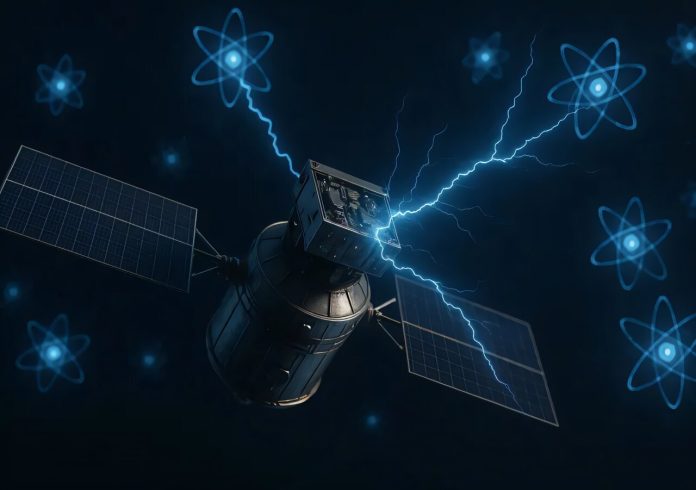
For the first time, researchers have found that the number of electrical discharges on a spacecraft directly correlates to the number of electrons in the surrounding environment.
Spacecraft environment discharges (SEDs) are transient electrical breakdowns that can damage sensitive onboard electronics and communication systems.
Uncovering information about these discharges could help scientists better understand how to protect equipment in space.
“We’ve long known that these SEDs exist; however, we haven’t understood the relationship between the electrons in the space environment and SEDs,” commented Amitabh Nag, a scientist at Los Alamos National Laboratory and lead author on a new paper detailing the research.
“To do that, we needed two sensors on a single spacecraft: one that looked at the number and activity of electrons, and another that looked at the radio frequency signal.”
What causes electrical discharges on spacecraft?
EDs are typically the result of a difference in surface charging caused by electrons accumulating on spacecraft surfaces in orbit.
Electrical discharges in the space traffic environment are similar to static electricity on Earth – when energy builds up as a person walks across a carpet, for example, and causes a spark when a finger touches a door handle.
They occur when a buildup of energy on the spacecraft reaches a sufficiently large voltage, causing the energy to be released.
Examining radio frequency and electron activity simultaneously
A Department of Defense satellite in geostationary orbit, called STP-Sat6, has dual sensors on board, giving the researchers a unique opportunity to simultaneously look at both radio frequency and electron activity data.
“We were able to see the rate of SEDs reported by the radio frequency sensor and compare it to the activity of electron particles within a certain voltage range,” Nag said.
“What we learned was that the peaks in SEDs correlated to peaks in electron activity.”
The team analysed more than a year’s worth of data from the two sensors, both developed by the Laboratory, identifying over 270 high-rate SED periods and several hundred episodes of high electron activity.
The role of electrons in causing spacecraft environment discharges
In about three-fourths of the cases, peaks in electron activity preceded the SED events by 24 to 45 minutes. This delay suggests that the buildup of charge from low-energy electrons plays a key role in priming the spacecraft for electrostatic discharges.
Nag explained: “We observed that as electron activity increases, especially in that 7.9 to 12.2 keV range, the spacecraft starts to accumulate charge. This process continues until a tipping point is reached, at which point SEDs occur.”
“That lead time opens the door for potential forecasting tools to mitigate risks,” he added.
In the future, missions could integrate real-time monitoring of low-energy electrons to predict and respond to charging events before they impact operations.