The world’s newest sentinel in the fight against climate change is now orbiting Earth.
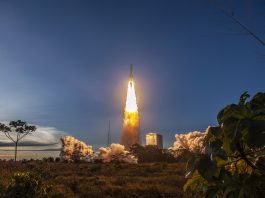
The Copernicus Sentinel-6B satellite blasted off today, embarking on a mission to monitor sea-level rise with unprecedented precision.
As rising oceans threaten millions of people living along coastlines, this advanced satellite will continue a decades-long effort to track changes in the height of the world’s seas – data that is critical for shaping climate policy and safeguarding vulnerable communities.
A smooth launch marks new chapter in sea-level monitoring
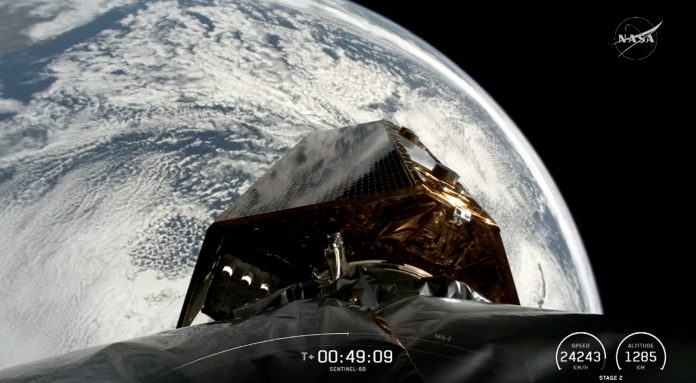
Sentinel-6B lifted off at 06:21 CET from Vandenberg Space Force Base in California aboard a SpaceX Falcon 9 rocket.
Less than an hour later, the satellite reached orbit, and at 07:54 CET, ESA’s European Space Operations Centre in Germany confirmed receipt of the first signal via the Inuvik ground station in Canada.
This signalled that Sentinel-6B was fully operational and ready to continue its critical mission.
Continuing a legacy of ocean observation
Sentinel-6B follows in the footsteps of Sentinel-6 Michael Freilich, launched in November 2020.
Both satellites are part of the Copernicus Sentinel-6 mission, the world’s primary reference for measuring sea-surface height from space.
This mission builds on decades of observations, beginning with the early 1990s Topex-Poseidon satellite, and later continued through the Jason satellite series.
These continuous records have become essential tools for understanding long-term sea-level rise, a phenomenon that threatens millions living along coastlines worldwide.
Advanced technology for accurate measurements
Equipped with state-of-the-art radar altimetry instruments, Sentinel-6B measures the height of the ocean surface by timing radar pulses sent to Earth and returned to the satellite.
Precise satellite positioning allows scientists to calculate sea-surface heights with unprecedented accuracy. Additionally, an advanced microwave radiometer, supplied by NASA, corrects for atmospheric water vapour, ensuring measurements remain precise.
Beyond measuring sea-level rise, Sentinel-6B also gathers vital operational data, such as wind speed and significant wave height. These observations feed into near-real-time ocean forecasts, benefiting shipping, weather prediction, and coastal management.
International cooperation at its best
Although Sentinel-6B is part of the European Union’s Copernicus programme, it exemplifies international collaboration.
The mission brings together ESA, the European Commission, Eumetsat, NASA, NOAA, and France’s CNES, pooling expertise, technology, and resources to provide the highest-quality ocean data.
ESA’s Director of Earth Observation Programmes, Simonetta Cheli, explained: “Collaboration between partners is key to a mission such as Sentinel-6, and my thanks go to everyone involved in developing, launching and operating this exceptional satellite.
“This achievement demonstrates what can be accomplished when international agencies and industries work together toward a shared goal.
“Sentinel-6B will ensure that we continue to collect the high-precision data needed to understand our changing climate, safeguard our oceans and support decisions that protect coastal communities around the world.”
Why ocean monitoring matters
Tracking sea-level rise is not just a scientific exercise – it has profound societal implications.
Rising seas contribute to coastal flooding, erosion, and saltwater intrusion, threatening infrastructure, ecosystems, and human populations. Long-term monitoring helps governments plan climate adaptation strategies, from seawalls to managed retreats.
Satellites like Sentinel-6B are vital because they provide a global perspective impossible to achieve with tide gauges alone.
Continuous measurements allow scientists to detect subtle trends and seasonal variations, offering early warning of accelerated sea-level rise. Moreover, satellite data enhances climate models, helping policymakers make informed decisions on mitigation and disaster preparedness.
Next steps for Sentinel-6B
Currently, Sentinel-6B is being managed by ESA’s mission control in Germany through its ‘Launch and Early Orbit Phase.’ Once this phase is complete, operational control will transfer to Eumetsat, which will oversee the satellite’s long-term data collection and distribution.
With Sentinel-6B now in place, the Copernicus Sentinel-6 mission ensures that the global community has the tools to monitor oceans with unmatched precision, continuing a decades-long record that is essential for understanding our changing planet.