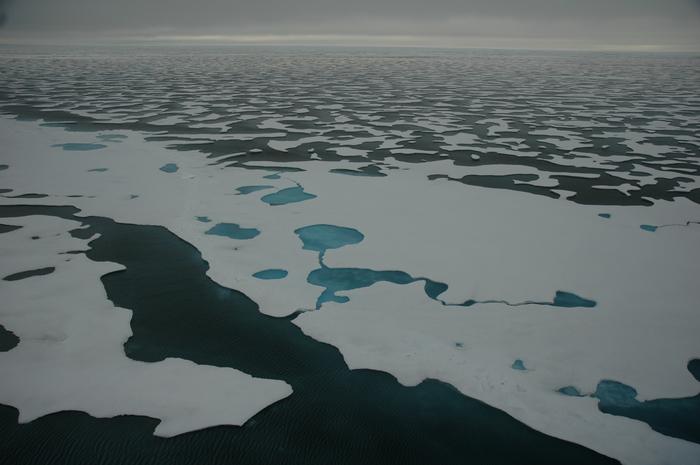
Arctic sea ice has declined by more than 42% since 1979, when regular satellite monitoring began.
Climate models indicate that the Arctic will experience ice-free summers within the coming decades, and scientists are still uncertain about the implications for life on Earth.
Researchers have known for some time that fine-grained dust from space blankets the Earth’s surface, falling from the cosmos at a constant rate and settling into ocean sediments.
Now, a new study from the University of Washington reveals that tracking where cosmic dust has fallen and where it hasn’t can provide insight into how Arctic sea ice coverage has changed over time.
“If we can project the timing and spatial patterns of ice coverage decline in the future, it will help us understand warming, predict changes to food webs and fishing, and prepare for geopolitical shifts,” said Frankie Pavia, a UW assistant professor of oceanography, who led the study.
Measuring cosmic dust levels across the Arctic
Cosmic dust swirls through space after stars explode and comets collide. As the Sun passes, cosmic dust is implanted with a rare form of helium, known as helium-3.
Pavia explained: “It’s like looking for a needle in a haystack. You’ve got this small amount of cosmic dust raining down everywhere, but you’ve also got Earth sediments accumulating pretty fast.”
For this study, Pavia was more interested in the absence of cosmic dust.
“During the last ice age, there was almost no cosmic dust in the Arctic Ocean sediments,” he said.
The researchers hypothesised that cosmic dust could serve as a proxy for ice before satellites were available to monitor changes in Arctic sea ice coverage. Ice at the sea surface blocks cosmic dust from reaching the seafloor, while open water allows cosmic dust to settle into sediment.
By analysing the amount of cosmic dust in sediment cores from three sites, researchers reconstructed the history of sea ice for the past 30,000 years.
Higher Arctic sea ice levels indicate less cosmic dust
The researchers found that year-round Arctic sea ice coverage corresponded with less cosmic dust in the sediment. This was also observed during the last ice age, around 20,000 years ago.
The researchers then matched ice coverage to nutrient availability, showing that nutrient consumption peaked when sea ice coverage was low and decreased as ice coverage increased.
How do ice levels impact the food chain?
The data on nutrient cycling comes from tiny shells once occupied by nitrogen-digesting organisms called foraminifera. Chemical analysis of these organisms’ shells reveals the percentage of total available nutrients consumed during their lifetime.
“As ice decreases in the future, we expect to see increased consumption of nutrients by phytoplankton in the Arctic, which has consequences for the food web,” Pavia said.
Additional research is needed to determine what factors are driving changes in nutrient availability.
One hypothesis suggests that sea ice decline increases the amount of nutrients used by surface organisms due to increased photosynthesis, but another argues that nutrients are diluted by the melting of Arctic sea ice.
Both scenarios present more consumption, but only the first indicates an increase in marine productivity.