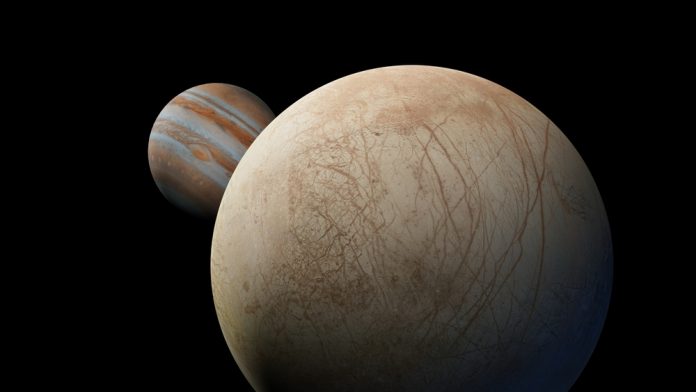
A recent study by geophysicists at Washington State University offers insight into how nutrients may reach the subsurface of Europa’s ocean, one of Jupiter’s moons and a leading candidate for extraterrestrial life in our Solar System.
Scientists have long wondered how life-sustaining nutrients could make it from the surface into Europa’s ocean, where microscopic life is believed to exist.
Drawing on the geological process of crustal delamination, the research team used computer modelling to show that dense, nutrient-rich ice can separate from the surrounding ice and descend into the ocean.
“This is a novel idea in planetary science, inspired by a well-understood idea in Earth science,” stated Austin Green, who led the study.
“Most excitingly, this new idea addresses one of the longstanding habitability problems on Europa and is a good sign for the prospects of extraterrestrial life in its ocean.”
Conditions of Europa’s ocean raises questions about its habitability
Europa contains more liquid water than all of Earth’s oceans combined, but its global ocean lies beneath a thick shell of ice that blocks sunlight.
The icy shell means that any life in Europa’s ocean has to find nutrient and energy sources other than the Sun, raising longstanding questions about how it could be habitable.
Europa is also constantly bombarded by intense radiation from Jupiter. The radiation interacts with salts and other materials on Europa’s surface to form useful nutrients for oceanic microbes.
Although several theories exist, scientists are unsure how that nutrient-rich surface ice can penetrate the icy shell layer to reach the ocean layer.
While Europa’s icy surface is highly geologically active due to Jupiter’s gravitational pull, the ice mostly shifts side to side rather than in the downward motion necessary for surface-ocean exchange.
Weakening Europa’s surface ice
The researchers decided to look to Earth for possible explanations and solutions to the surface recycling problem.
They decided on the crustal delamination concept, in which a crustal zone is tectonically squeezed and chemically densified until it detaches and sinks into the mantle.
The researchers thought this concept might apply to Europa, since various regions of the ice surface are enriched in densifying salts. Other studies have shown that ice crystalline structure is weakened by included impurities and is less stable than pure ice.
However, to trigger delamination, the ice surface needs to be weakened so it can detach and sink into the interior of the icy shell.
The research team proposed that denser, saltier ice, surrounded by pure ice, would sink into the interior of the ice shell, providing a means to recycle Europa’s surface and feed the ocean.
Using computer modelling, they determined that nutrient-rich surface ice can sink to the base of the ice shell for almost any salt content, provided there is at least a little weakening in the surface ice.
The process is also relatively rapid and could be a consistent means of recycling ice and providing nutrients into Europa’s ocean.
Advancing the goals of the Europa Clipper mission
The findings closely align with the primary goals of the Europa Clipper, a NASA flagship mission launched in 2024 to investigate Europa’s ice shell, ocean, and potential to support life using a suite of scientific instruments.