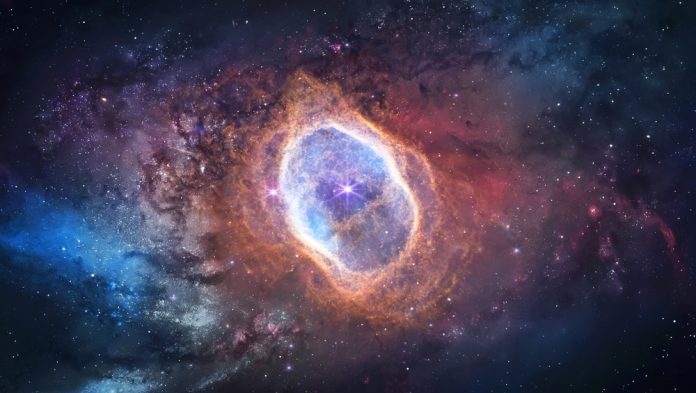
A team of European astronomers has uncovered a striking, bar-shaped cloud of iron within the well-known Ring Nebula, offering an unexpected glimpse into the inner workings of this celestial spectacle.
The discovery, led by researchers from Cardiff University and University College London (UCL), represents the first time such a structure has been observed in the nebula.
This newfound feature appears as a narrow strip of iron atoms, perfectly aligned inside the inner layer of the nebula’s elliptical shell.
Its immense scale is staggering: the bar stretches roughly 500 times the distance from the Sun to Pluto, and the total mass of iron is comparable to that of Mars.
The Ring Nebula: A celestial classic
First observed in 1779 by French astronomer Charles Messier, the Ring Nebula resides in the northern constellation Lyra.
It is a luminous shell of gas expelled by a star nearing the end of its life cycle – a fate our Sun will share billions of years from now.
Over centuries, the nebula has been imaged extensively, including through the infrared lens of the James Webb Space Telescope, yet this iron bar had remained hidden until now.
How the discovery was made
The breakthrough was made possible by the WHT Enhanced Area Velocity Explorer (WEAVE), a new instrument installed on the 4.2-metre William Herschel Telescope at the Isaac Newton Group.
Using WEAVE’s Large Integral Field Unit (LIFU) mode, astronomers obtained spectra at every point across the nebula, spanning all optical wavelengths.
This unprecedented spectral mapping allowed the team to visualise the chemical composition of the Ring Nebula in exquisite detail for the first time.
Dr Roger Wesson, lead author and astronomer at both UCL and Cardiff University, explained that while the nebula has been extensively studied with numerous telescopes, WEAVE offered an entirely new perspective.
“WEAVE has allowed us to observe it in a new way, providing so much more detail than before.
“By obtaining a spectrum continuously across the whole nebula, we can create images of the nebula at any wavelength and determine its chemical composition at any position,” he noted.
The origins of the iron bar remain a mystery
Despite the excitement of discovery, the formation of the iron bar is still uncertain.
Researchers are exploring two primary hypotheses: the bar could indicate an unusual pattern in how the parent star expelled its outer layers, or it might be the result of vaporised material from a rocky planet engulfed by the star during its expansion.
Professor Janet Drew, co-author from UCL, emphasised that further analysis is needed. Determining whether other chemical elements are associated with the iron could provide essential clues about the bar’s origin and help refine theoretical models.
Next steps in understanding the Ring Nebula
The team is preparing follow-up observations with WEAVE’s LIFU at higher spectral resolution to probe the iron bar in more detail.
These studies aim to clarify the processes shaping this enigmatic feature and to explore whether similar structures exist in other nebulae.
WEAVE is currently conducting eight major surveys over five years, ranging from nearby white dwarfs to distant galaxies.
The Stellar, Circumstellar, and Interstellar Physics survey, led by Professor Drew, is focused on examining ionised nebulae across the northern Milky Way.
Dr Wesson suggested that discoveries like the iron bar may not be unique to the Ring Nebula, and further observations could reveal more such phenomena.
As astronomers continue to map the Ring Nebula and other stellar remnants in unprecedented detail, this discovery opens a new window into the complex processes governing the life and death of stars – and the unexpected treasures they leave behind.