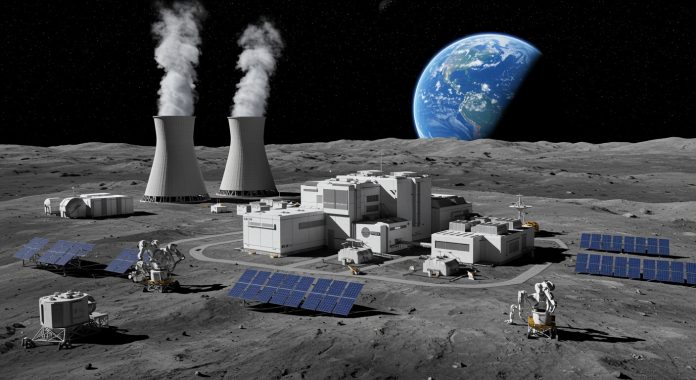
As global interest in lunar exploration intensifies, China is charting an ambitious path to the Moon – one that includes building a nuclear reactor on the Moon’s surface.
This bold initiative is part of their joint effort with Russia to develop the International Lunar Research Station (ILRS), a long-term scientific outpost near the lunar south pole.
Designed to operate autonomously and support a wide range of experiments, the ILRS could redefine international collaboration in space, and a lunar-based nuclear reactor may be the key to powering it all.
According to a recent presentation by Pei Zhaoyu, chief engineer of China’s 2028 Chang’e-8 mission, the ILRS’s energy infrastructure will combine large-scale solar arrays with a nuclear reactor placed on the Moon’s surface.
The nuclear reactor is expected to ensure reliable, long-term power generation in the challenging lunar environment, particularly during the two-week-long lunar nights.
How ILRS will explore and utilise the Moon
The ILRS is envisioned as a scalable and autonomous lunar base that will support a wide range of scientific and technological missions.
Located near the Moon’s south pole – a region believed to contain water ice – the station will facilitate studies in lunar geology, astrophysics, resource extraction, and moon-based Earth observation.
Construction will take place in phases. A “basic model” of the station is expected to be completed by 2035, with a more expansive version targeted for 2050.
The ILRS is also being positioned as a platform for future deep space missions and will foster broad international collaboration. China’s “555 Project” aims to invite 50 countries, 500 scientific institutions, and 5,000 researchers to participate.
Chang’e-8: Testing tech for lunar living
Scheduled for launch in 2028, the Chang’e-8 mission will play a pivotal role in preparing for the ILRS. The mission includes a lander, rover, and a multifunctional robotic unit to test technologies such as in-situ resource utilisation (ISRU).
Experiments will focus on transforming lunar soil into building materials, potentially using 3D-printing techniques to support sustainable lunar construction.
The spacecraft will also carry about 200kg of international scientific payloads, reinforcing China’s commitment to global partnerships in space.
A new chapter in lunar competition
China’s lunar ambitions run parallel to NASA’s Artemis programme, which plans to return astronauts to the Moon by December 2025.
While the US aims to establish a sustainable human presence, China and Russia’s ILRS represents a competing vision – one powered, quite literally, by a nuclear reactor on the Moon.
As space powers race to build infrastructure beyond Earth, the Moon is rapidly becoming the next frontier in geopolitical and scientific rivalry.