A new £5m initiative, spearheaded by the University of Exeter, is set to transform the way scientists understand the Sun’s atmosphere.
Backed by the Science and Technology Facilities Council (STFC) under its prestigious Large Award scheme, the Solar Atmospheric Modelling Suite (SAMS) project will run over five years, aiming to decode the complex physical processes occurring in the Sun’s outer layers.
Professor Andrew Hillier from the University of Exeter explained: “For a long time the UK was leading the way in simulating the atmosphere of the Sun, but in recent years we have been eclipsed.
“This project will put us right back as one of the leaders in this area.”
The Sun’s activity is far from a distant astronomical curiosity – it directly impacts life on Earth. Solar flares and eruptions can disrupt satellite communications, affect power grids, and pose dangers to astronauts in space.
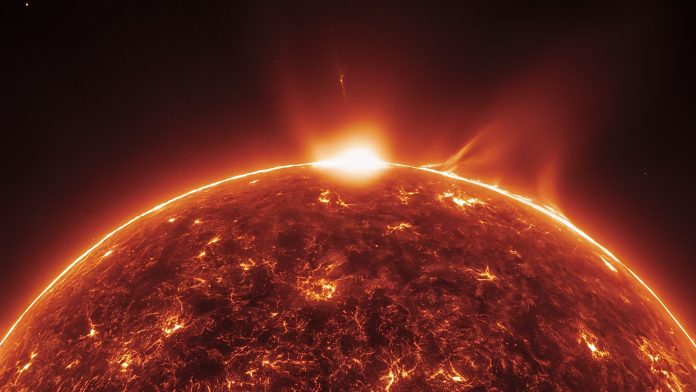
At the heart of this dynamic system lies the Sun’s atmosphere, comprising the photosphere, chromosphere, and corona, where magnetic fields and plasma interactions trigger the phenomena we observe as solar storms and space weather.
The SAMS project aims to revolutionise our understanding of the Sun’s atmosphere by developing advanced modelling tools to predict solar activity and protect Earth’s technology.
A cutting-edge challenge in solar physics
Despite major advancements in observational technology, no current model fully captures the intricate interaction between radiation, magnetism, and plasma across the different layers of the Sun’s atmosphere.
The need for an advanced, high-fidelity model is urgent, not only to interpret the new wave of high-resolution solar data but also to enable predictive capabilities essential for mitigating the impact of solar activity on Earth.
SAMS aims to bridge this critical gap. The project will develop an advanced, open-source simulation code capable of running on everything from laptops to supercomputers.
By incorporating detailed, physics-based documentation and world-leading simulation features, SAMS will enable researchers to visualise and understand the turbulent mechanisms that govern the solar atmosphere with unprecedented detail.
Uniting UK expertise
Led by the University of Exeter, the SAMS collaboration also includes solar physics experts from the universities of Warwick, Sheffield, and Cambridge.
The project will draw on decades of UK leadership in computational plasma physics, seeking to re-establish the country at the forefront of global solar modelling efforts.
By building on Warwick’s internationally recognised strengths in plasma simulations, the SAMS suite will provide a flexible and powerful toolset for the global research community.
This strategic effort also ensures that the UK remains a leader in interpreting and exploiting data from next-generation solar observatories and space missions.
Equipping the next generation of scientists
Beyond building a state-of-the-art modelling tool, SAMS will play a vital role in training early-career researchers.
The project will provide hands-on experience in modelling the Sun’s atmosphere, supporting the development of new talent in astrophysics and computational science.
This human capital investment is key to sustaining a vibrant research ecosystem capable of responding to future technological and scientific challenges.
Safeguarding Earth through solar insight
Ultimately, the SAMS project is about more than theoretical exploration – it’s a vital step in protecting Earth’s technological infrastructure.
Understanding the Sun’s atmosphere and its capacity for powerful outbursts can lead to better space weather forecasting, enabling industries and governments to safeguard critical systems like communication satellites, navigation tools, and power grids.
With this bold investment, the UK positions itself once again at the cutting edge of solar physics, ready to illuminate the mysteries of the Sun’s atmosphere.