Professor Michael Fitzpatrick, expert in nuclear technologies at Coventry University, discusses NASA’s plans to deploy a small nuclear reactor on the Moon by 2030, ensuring reliable power for lunar habitats and preparing for Mars exploration.
From the Apollo era to today’s renewed push for lunar exploration, America’s ambitions in space are entering a bold new chapter – one aimed at building a lasting human presence beyond Earth.
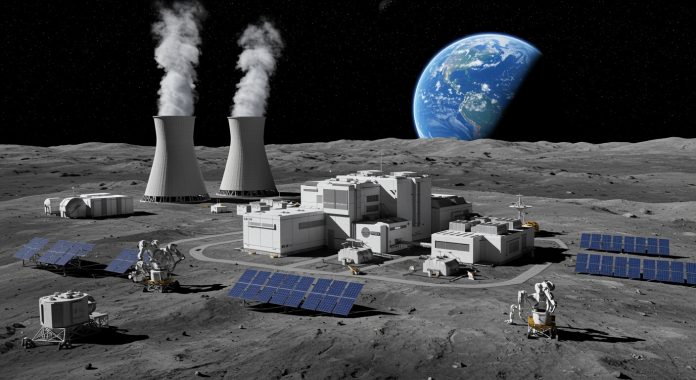
The Moon, just three days away by spacecraft, is set to serve as both a proving ground for advanced space technologies and a strategic launch point for future Mars missions. Creating a sustainable base there will require overcoming some of the harshest conditions in the solar system, from extreme temperature swings to two-week-long nights with no sunlight.
Meeting these challenges demands reliable, round-the-clock energy, and for the United States, the development of a nuclear reactor on the Moon is emerging as a game-changing solution.
Against this backdrop of technological ambition and extreme lunar challenges, Professor Fitzpatrick discusses the United States’ plans to develop a nuclear reactor on the Moon and why it could be essential for sustaining a long-term human presence.
Why do you think NASA and the US are prioritising the development of a nuclear reactor on the Moon?
Essentially, if we’re going to have a facility on the Moon that is, in a way, the equivalent of the International Space Station (ISS) – somewhere people can live and work for long periods – a nuclear reactor is really the only practical source of power.
There’s no wind on the Moon, and although you can use solar power, the problem is that the Moon has very long periods of darkness. To cope with that using solar, you’d need vast amounts of battery storage, which quickly becomes unfeasible.
If you want a truly reliable energy source, you need a nuclear reactor. That’s why they’re prioritising it now, so that the technology will be ready and in place by the end of the decade.
So, in your expert opinion, it has to be nuclear because of the extreme lunar conditions?
Yes, it does. At the moment, that’s the only technological option available.
If you look back at the Apollo missions, those were very short stays with limited power needs, and they used chemical fuel cells. That is a workable technology, but the problem is that you have to keep shipping fuel and replenishing it.
Straight away, that adds risk – if there’s a problem with a shipment or you can’t access the fuel for any period of time, you lose power. Nuclear provides a much more reliable source of energy, which is exactly what you need for something that has to operate safely for long periods.
Are there existing nuclear systems or prototypes that could be adapted for the Moon, or will it require entirely new technology?
It’s not going to require a whole new technology. We’ve been developing nuclear power technologies for more than half a century, and they’ve been deployed commercially for a long time.
Alongside the large-scale commercial reactors, there have been concepts for smaller ones as well. So, this isn’t really ‘new’ technology, it’s more about taking existing designs and evolving them for this particular application.
From a technical standpoint, what would be the biggest engineering or logistical challenges?
I think the main challenge will be designing something that can be built in a way that allows it to be shipped to the Moon, and then assembled and connected on-site as simply and safely as possible.
On Earth, when we build a reactor, it stays in place; that’s it. On the Moon, you’re going to have to build it, ship it on a rocket – either as a single unit or in modules – then reassemble it and turn it on.
That’s a big difference from what we currently do, and it’s where a lot of the design focus will have to go.
How dangerous would that be? Would you expect the reactor to be transported separately from the crew?
It’s actually not particularly dangerous. Although people think of nuclear reactors and fuel as hazardous, the danger comes from the radioactive fission products, and those don’t exist until the reactor has started operating.
When you ship the fuel, whatever form of uranium it is, it’s still relatively benign. Yes, it’s slightly radioactive, but to put that in perspective, if you ate it (which I wouldn’t recommend), you’d die from heavy metal toxicity before radiation poisoning.
If there were a launch accident and the whole thing was destroyed, it wouldn’t be a nuclear accident. It would just spread some uranium dust, which is a chemical hazard, not a nuclear explosion. From that perspective, transporting it to the Moon isn’t a major hazard.
So, it sounds less dangerous than it might seem at first?
Yes, exactly. At the point of shipping, it’s not an operating reactor – it’s just a piece of machinery with some uranium inside.
Only when it goes ‘critical’ – meaning the moderator is in place and the chain reaction starts – does it become an operating reactor producing fission products. Before that, it’s a fairly inert system with low radioactivity. You and I could sit across a table from it with no particular hazard at all.
We haven’t set foot on the Moon since the 1970s, and the goal is to have this up and running by 2030. Is that timeline ambitious, realistic, or overly optimistic?
I think it’s achievable. Given that it’s now 2025, it’s ambitious, but definitely possible.
The planned reactor is small – about 100 kilowatts of power. For comparison, commercial reactors on Earth produce over a thousand times more power.
That smaller scale makes it relatively easy to design and build, because you’re not dealing with huge heat loads or complex supporting systems. The design will be kept simple, with straightforward interfaces to the systems it powers.
We’ll need to get moving quickly, but designs for this sort of small reactor, sometimes called nuclear batteries, have existed for some time, especially since nuclear power began to see renewed interest. There are designs ranging from this size or smaller right up to gigawatt-scale plants.
So, we’re not starting from a blank sheet of paper. The ideas are already there.
You mentioned it’s a small reactor. How large of a mission could it sustain, and would capacity be increased over time?
To give you a comparison, Sizewell C or Hinkley Point C in the UK could power around six million homes. A 100-kilowatt reactor would power only a fairly large street or a small neighbourhood – roughly the equivalent of 30 kettles all switched on at once.
It’s small. But it would be used alongside battery storage, so you’d average out the power use and smooth out peaks and troughs.
For an initial Moon base supporting a few dozen people, running equipment, and perhaps charging rovers, one unit would be fine. Over time, as the base grows, you’d add more units. When older ones reach the end of their lives, you’d replace them.
No one is suggesting you’d install just one and leave it at that. One would be the starting point for a scalable power system.
Other nations are also looking at lunar settlements. Is this the start of a new space race?
I think it is, in a way. Many countries see the opportunities, not only in accessing resources we don’t currently have, but also in reducing the risk of having all of humanity on one planet. Every year, more asteroids are identified that could one day cause catastrophic damage.
Hopefully, this ‘space race’ will be more collaborative than in the past. The ISS is a great example of successful cooperation in space. Ideally, we’d have a mix of collaboration where it makes sense and healthy competition to drive technology forward, as long as the end result benefits everyone.
If successful, could this technology be instrumental in future missions, such as to Mars?
Absolutely – in fact, this is a necessary first step.
Testing these technologies on the Moon, which is far closer, lets us see what works and what doesn’t in a relatively short time. That allows for rapid refinement before attempting longer missions to Mars.
It’s worth remembering that nuclear power has already been used in space in much smaller systems, mainly to generate heat for spacecraft instruments. This project builds on that proven technology, but scales it up to support a permanent human presence.