With the advent of digital farming, information on soil health remains in the dark. SQAT provides a cost-effective solution, leading to lower farming costs and a smaller environmental footprint.
The ground is shifting under our feet.
The Soil Observatory of the EU has found that 89% of agricultural soils in Europe are degraded. Industrial farming practices, including intensive use of mineral fertilisers and intensive tillage, have degraded soil health and threaten long-term fertility.
As the predominant medium for food production, healthy soils are crucial for long-term food security. They are also important for a farmer’s bottom line, directly affecting agricultural productivity.
As the need for sustainable agriculture rises, it’s imperative for farmers to know their soil in order to understand and then manage it. Soil Quality Analysis Tool: Implementing Smart Farming Applications using EO Data, Soil Sensors & Robotics (SQAT) – is an EU-funded initiative that brings together advanced technologies to deliver high-resolution soil insights and smarter farming practices.
Managing soil health
For a farmer, a healthy soil is a valuable resource. It has a good structure, allowing air to reach plant roots. It soaks up and maintains moisture. And, together with beneficial microorganisms, it stores and releases nutrients needed for plant growth.
Soil is key for water filtration and waterbody regulation, as well as for nitrogen and carbon cycles, including its role as a large carbon sink. Soil contains 25% of the planet’s biodiversity: a teaspoon of healthy soil can host 1 billion microorganisms.
Presently, a farmer’s soil treatment is calculated on the level of a whole field. This is much like tailoring football uniforms using a team’s average height: they are likely to fit no player well. Similarly, for the farm, it means providing too much or too little of a treatment for almost every point of the field.
Though modern farms are increasingly integrated into the digital economy – with data-informed approaches shaping production – the digital domain is yet to fully penetrate the surface: detailed data about the undulation of soil health is still largely ‘in the dark.’
Traditional soil analyses are reliant on lab work and manual sampling, generally providing farmers with point values – once again, tailoring team uniforms based on the height of a few players. More precise alternatives are often prohibitively expensive. As a result, soil variability is insufficiently assessed, preventing precision management that could restore soil health, optimise input use, and reduce environmental impact.
The SQAT method
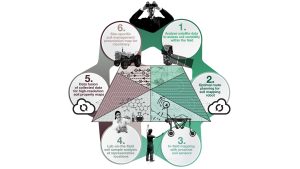
The SQAT project responds to these challenges by offering a multi-level, multi-technology soil mapping service – integrating Earth Observation, robotics, sensors and smart data to provide a detailed and accurate map of field soil properties at a uniquely affordable cost.
At the heart of the system are autonomous, GNSS-powered, robot-mounted sensors, automated sampling drills, penetrometers, and an innovative ‘lab in the field’ chamber for in-situ wet-chemical soil analysis. Combined with satellite data (notably from the Copernicus programme) and AI-driven processing, SQAT generates high-resolution maps detailing soil properties across entire fields.
In Belgium, the SQAT robot was showcased at Werktuigendagen 2025, one of the region’s largest agricultural machinery fairs. Demonstrations of automated sampling and in-field analysis drew strong interest from farmers, cooperatives, and agri-service companies – early signs of commercial appetite for precision soil mapping. Across all pilot sites, SQAT’s approach aims to prove that high-resolution soil intelligence can be accessible, scalable, and economically viable, even for mid-sized or smaller farms.
SQAT isn’t just about producing maps – it’s about transforming them into actionable farming decisions. Affordable soil properties maps enable better farm variability management and deliver important cost savings for farmers. To demonstrate this fact, SQAT is directly developing five smart farming applications that save on fuel, seed, fertiliser, and lime: variable-rate liming, variable-rate seeding, variable-depth tillage and variable-rate macronutrient fertilisation. While also monitoring carbon for carbon sequestration and soil organic matter restoration.
The project has established seven real-world use cases across Europe, demonstrating its ability to adapt to different soils, climates, and farming systems.
Long-term impacts
Providing tools to monitor and protect soil health can reverse perilous trends in soil degradation. Degraded soils diminish the ability to produce food in the future, and reversing these trends is key to long-term food security.
Similarly, maintaining soil health is key to maintaining highly valuable ecosystem services: water filtration, flood regulation, regulating air quality, carbon storage, etc. With growing urbanisation and irregular weather patterns from climate change, these services are increasingly important.
From the farmer’s perspective, fluctuations in input/output prices as well as drastically changing weather patterns have financial consequences and require new tools at their disposal. Affordable soil properties mapping to underpin precision soil treatments helps cut costs and increase (or at least maintain) yields – improving farm financial resilience.
Better soil intelligence informs soil stewardship and thus enables greater soil resilience in the face of climate shocks and extreme weather events, such as droughts and floods.
Why SQAT matters – For farmers, environment, and climate
The project has shown that, by lowering the cost barrier for soil analysis, we make precision-agriculture tools accessible, allowing even smaller farms to tailor their practices to the actual needs and conditions of their soils.
Informed input use is a fundamentally green measure: lower use of lime, fertilisers, and fuel lowers the environmental and climate footprint of food. Variable macronutrient fertilisation will lower the currently significant runoff into rivers and the associated pollution.
Through better soil management and carbon farming support, SQAT contributes to climate-change mitigation and long-term fertility. It also provides a new tool for efficient use of inputs, supporting farmer compliance with the Nitrate Directive without sacrificing yield. It enables farmers to join the digital and green transition as envisioned by the EU Green Deal.
For farmers across Europe – especially those facing soil degradation and resource pressures – SQAT could become a game changer. As the project advances toward commercial deployment by 2027, it’s worth watching closely.
SQAT is co-funded by the EU and the Swiss Confederation