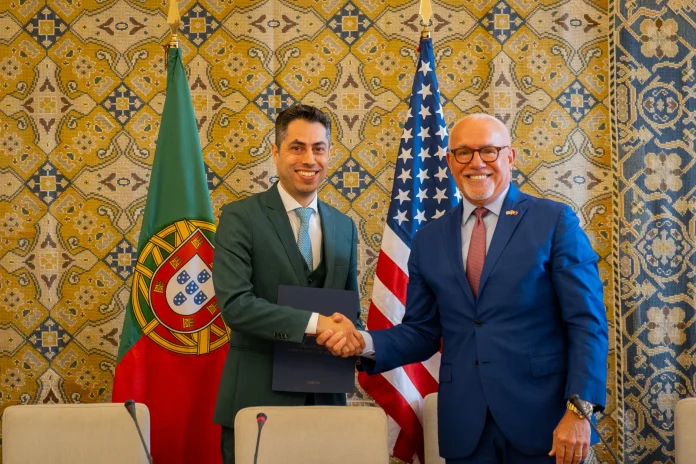
Portugal has officially joined a growing list of nations committed to advancing responsible space exploration by signing the Artemis Accords.
The signing was led by Portugal’s Secretary of State for Science and Innovation, Helena Canhão, during a ceremony in Lisbon coinciding with a semi-annual US-Portugal government cooperation meeting.
Portugal becomes the latest of 60 countries to endorse the agreements, reinforcing its commitment to international collaboration in lunar, Martian, and broader space missions.
Speaking on the signing, Hugo Costa, Executive Director of the Portuguese Space Agency, said: “2026 is the year in which humans will return to the Moon.
“It will mark the beginning of a new era of space exploration, reminiscent of the Portuguese explorers of the past, such as Magellan and his circumnavigation of our planet.
“As a nation that approaches space sustainability with great care and responsibility, Portugal and the Portuguese Space Agency are proud to join the Artemis Accords and contribute to the sustainable, beneficial, and peaceful use of space for all humankind.”
Origins of the Artemis Accords
The Artemis Accords were established in 2020 by NASA and the U.S. Department of State, together with seven founding nations. The initiative was launched in response to growing interest in lunar activities by both governments and private companies.
These accords introduced the first practical set of principles for civil space exploration, creating a framework to enhance safety, transparency, and coordination for missions beyond Earth.
Since their creation, the number of signatory nations has steadily increased as more countries seek to participate in space exploration responsibly.
Key principles of the Artemis Accords
The Artemis Accords outline a range of commitments for signatory nations to ensure that space activities are conducted safely, sustainably, and for the benefit of all.
Core principles include:
- Peaceful and transparent exploration: All space operations are to be conducted for peaceful purposes, in line with the Outer Space Treaty. Signatories are committed to openly sharing information about national space policies and exploration plans.
- Interoperability of systems: To support safe and effective missions, nations agree to adopt current interoperability standards and develop new ones as needed.
- Emergency assistance: Countries commit to providing aid to astronauts in distress, in line with the Rescue and Return Agreement.
- Registration of space objects: Accurate registration supports coordination and prevents harmful interference among space activities.
- Preservation of heritage: Historically significant sites and artefacts in space are to be protected.
- Sustainable resource use: Extraction and utilisation of resources on the Moon, Mars, and asteroids must follow treaty obligations and support safe and sustainable exploration.
- Safety zones: Temporary operational zones can be used to prevent interference, with consideration for the nature of activities and adherence to principles of free access and due regard.
- Orbital debris mitigation: Signatories commit to planning for the safe disposal of spacecraft to minimise debris and ensure a sustainable space environment.
These principles reinforce existing international treaties while establishing operational guidance for cooperative space exploration activities.
Portugal’s role in international space cooperation
By signing the Artemis Accords, Portugal joins a framework that promotes international collaboration, scientific data sharing, and responsible exploration practices.
The Lisbon ceremony underscores the country’s participation in global space governance and its commitment to aligning national space initiatives with international standards.
The agreements also facilitate coordination between nations on joint missions and ensure that civil space operations are conducted safely and sustainably.
Global expansion of the Artemis Accords
Since their inception, the Artemis Accords have expanded from the original eight founding nations to 60 signatories, with more countries expected to join in the coming years.
This growing coalition reflects a worldwide commitment to transparent, peaceful, and cooperative space exploration.
NASA and other signatories emphasise that these accords are not only a framework for safe exploration but also a foundation for fostering peaceful international relationships and advancing shared scientific knowledge.
The signing of the Artemis Accords by Portugal marks a significant step in the global effort to create a coordinated, sustainable, and cooperative approach to exploring the Moon, Mars, and beyond, ensuring that space activities benefit all of humanity.