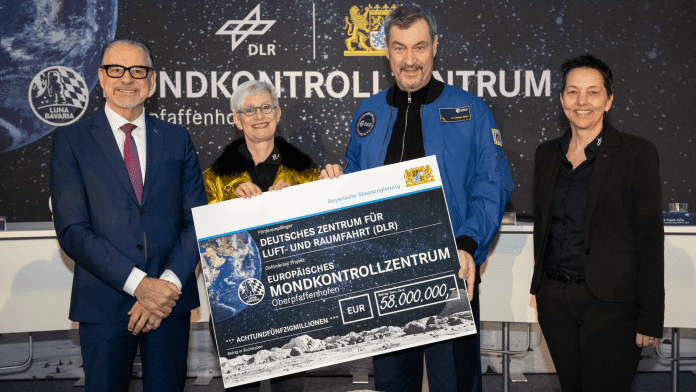
Germany is laying the groundwork for the next chapter of human spaceflight with a major investment in a new mission control facility near Munich.
The Human Exploration Control Center (HECC) will be built at the German Aerospace Center site in Oberpfaffenhofen, expanding Europe’s capabilities for crewed and robotic missions to the Moon and, eventually, Mars.
Backed by €58m from the Free State of Bavaria and an additional €20m from Deutsches Zentrum für Luft- und Raumfahrt (DLR) institutional funding, the project signals a long-term commitment to strengthening Europe’s independent role in space exploration.
Construction is scheduled to begin in 2028, with operations expected to start by 2030.
Commenting on the landmark facility, Bavarian Minister-President Markus Söder, commented: “Bavaria’s gateway to the stars is on its way. The Free State, DLR and ESA form a strong alliance. With innovation and pioneering spirit, we promote research, freedom and the future.
“Bavaria is investing €58m in a new building, as well as €5m in the development of an orbital gateway and an AI project to support astronauts. The Moon is our springboard into space – and perhaps one day a stopover on the way to Mars.
“From the Moon, real-time monitoring of robots, autonomous energy systems and permanent living and working in space can be explored. This is the most exciting adventure of our time, and it also has tangible effects for life on Earth. As a ‘Space Valley’, Bavaria will create numerous new technologies and jobs.”
A new era for human spaceflight operations
The HECC will become part of the German Space Operations Center (GSOC), which already manages complex missions, including operations for the European Columbus laboratory on the International Space Station (ISS).
Building on that experience, the new centre will expand Germany’s operational footprint beyond low Earth orbit.
Designed to accommodate up to 200 specialists, the HECC will include high-security control rooms, dedicated server facilities, and clean rooms for preparing sensitive flight hardware.
A dedicated lunar control centre will allow teams to oversee multiple missions simultaneously, reflecting the growing complexity of future human spaceflight campaigns.
The facility will not only manage spacecraft but also develop new operational concepts tailored to deep space exploration. As missions extend farther from Earth, traditional real-time control becomes increasingly difficult, requiring fresh approaches to autonomy and mission planning.
Supporting the Gateway and Artemis missions
One of the HECC’s first major responsibilities will be supporting Europe’s contributions to the lunar Gateway, a space station planned to orbit the Moon later this decade.
Developed under the Artemis programme, Gateway will serve as a staging point for surface missions and as a testbed for technologies needed for Mars.
The Oberpfaffenhofen centre will oversee operations for several key Gateway components, including the International Habitat (I-HAB), the HALO Lunar Communication System and the ESPRIT Refuelling Module.
By taking operational responsibility for these modules, Germany and its European partners are positioning themselves at the heart of future human spaceflight beyond Earth orbit.
As Gateway takes shape, the HECC will ensure that European systems function seamlessly alongside international partners. This cooperation is central to Europe’s strategy of maintaining technological sovereignty while remaining deeply integrated into global exploration efforts.
Preparing for Mars and autonomous missions
Looking further ahead, the HECC is also being designed with Mars in mind. Communication delays between Earth and Mars can stretch to 40 minutes round-trip, making real-time control impossible.
To address this challenge, GSOC teams are developing artificial intelligence tools such as the Mars Exploration Telemetry-driven Information System, or METIS.
These systems are intended to support semi-autonomous spacecraft operations, a critical requirement for long-duration human spaceflight missions to the Red Planet.
Strengthening Bavaria’s space economy
The decision to build the HECC in Oberpfaffenhofen reinforces Bavaria’s reputation as one of Europe’s leading space regions.
The site already hosts astronaut training, satellite control and cutting-edge research. With the addition of the HECC, it is set to become a central node for human spaceflight in Europe.
Beyond exploration goals, the project is expected to generate high-skilled jobs and drive innovation in robotics, communications and AI.
As space activity becomes an increasingly important economic sector, Bavaria is positioning itself at the forefront of technologies that will shape future missions – from the Moon to Mars and beyond.