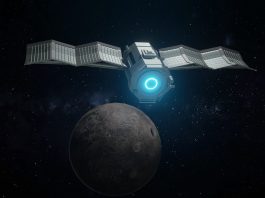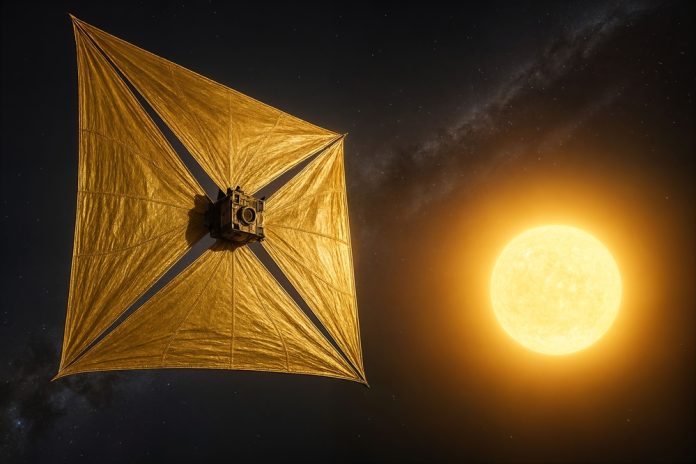
Solar sails and photonic propulsion represent significant advancements in the field of space exploration.
By utilising the momentum of sunlight and powerful lasers, these technologies offer a new approach to deep-space travel. They promise to achieve remarkable speeds without the constraints of traditional propellant systems.

However, the journey toward realising their full potential is fraught with technical challenges. What breakthroughs are necessary to transform these concepts into viable solutions for interstellar missions?
From science fiction to science fact: The evolution of light-driven propulsion
The concept of light-driven propulsion has transitioned from the realm of science fiction into a tangible scientific pursuit. Initially popularised in imaginative literature and films, the notion of harnessing light for propulsion has captivated researchers and enthusiasts alike.
Early visions of solar sails and photonic propulsion systems, depicted in works by authors like Arthur C. Clarke, sparked curiosity and laid the groundwork for serious investigation. As technological advancements unfolded, scientists began to explore the practical applications of these ideas, moving beyond mere theoretical frameworks.
Research institutions and space agencies have invested resources into developing prototypes and conducting experiments, showcasing the feasibility of light-based propulsion. This evolution reflects a broader trend in aerospace engineering, where innovative concepts are rigorously tested and refined.
The journey from speculative fiction to real-world applications signifies a pivotal moment in the quest for sustainable and efficient space exploration, opening new frontiers for humanity.
How solar sails work
Harnessing the momentum of light, solar sails operate on the principle of radiation pressure. When photons emitted by the Sun strike a reflective sail, they impart momentum to the surface. This interaction creates a thrust that gradually accelerates the spacecraft.
Unlike traditional propulsion systems that rely on fuel combustion, solar sails utilise the inexhaustible energy of sunlight, making them ideal for long-duration missions. The effectiveness of a solar sail is determined by its surface area and the intensity of incoming light; larger sails can capture more photons, generating greater thrust.
As the sail moves farther from the Sun, the available light diminishes, but the sail can still operate in interstellar space, harnessing light from distant stars. The fundamental physics of solar sails exemplifies a sustainable approach to space travel, offering a promising pathway for exploring the vast cosmos without relying on conventional fuel sources.
Photonic propulsion systems: Using lasers to power deep-space travel
Innovative photonic propulsion systems utilise powerful ground-based lasers to propel spacecraft on deep-space missions. These systems harness the momentum of photons emitted by lasers, which impart thrust to specially designed light sails attached to spacecraft.
By focusing high-intensity laser beams on the sails, the spacecraft can achieve significant acceleration without the need for onboard propellant. This method offers the potential for rapid travel across vast interstellar distances.
One of the key advantages of photonic propulsion is its ability to maintain acceleration over long periods, allowing spacecraft to reach speeds unattainable by traditional chemical rockets.
Additionally, as the laser beams can be directed from Earth, this technology enables collaboration across multiple nations and institutions, enhancing the feasibility of ambitious space missions.
Ultimately, photonic propulsion systems represent a transformative approach to deep-space travel, potentially opening new frontiers in humanity’s exploration of the cosmos.
Key missions paving the way
Breakthrough Starshot stands at the forefront of photonic propulsion missions, aiming to propel tiny spacecraft to Alpha Centauri using powerful laser systems. This ambitious initiative seeks to develop a fleet of gram-scale, light-driven probes that could reach speeds of up to 20% the speed of light.
By harnessing ground-based lasers to illuminate lightweight sails, these spacecraft are envisioned to traverse the vast distances of interstellar space in just over two decades.
Beyond Breakthrough Starshot, other missions are emerging that explore similar concepts. Initiatives such as the Planetary Society’s LightSail project demonstrate successful testing of solar sail technology, laying the groundwork for further advancements in propulsion systems.
Additionally, various academic and private research efforts are investigating novel approaches to interstellar travel, including advanced materials and propulsion concepts. Collectively, these missions represent significant steps toward realising humanity’s dream of exploring distant star systems.
Technical hurdles and design challenges
While the concept of interstellar flight captivates imaginations, several technical hurdles and design challenges must be addressed to make it a reality.
One significant challenge lies in achieving the necessary propulsion efficiency. Solar sails, for instance, rely on sunlight pressure, which diminishes with distance from the Sun, limiting acceleration.
Additionally, the durability of materials under harsh space conditions poses another concern, as sails must withstand extreme temperatures and micrometeoroid impacts over prolonged missions.
Energy generation is equally critical; the current reliance on solar power may be insufficient for deep-space travel, necessitating alternative energy sources or advanced power storage solutions.
Communication over vast distances presents its own difficulties, requiring innovative systems to relay information back to Earth.
Lastly, the vast time scales involved in interstellar missions demand careful planning and autonomous systems, as human intervention may not be feasible during extended journeys.
Addressing these challenges is essential for the future of interstellar exploration.
What light-based propulsion could unlock for humanity
Light-based propulsion systems, such as solar sails and photonic propulsion, promise to redefine humanity’s capabilities in space exploration.
By utilising the vast energy emitted by stars, solar sails can achieve unprecedented speeds without the need for conventional fuel. This capability opens up possibilities for exploring distant planets, moons, and even neighbouring star systems within a human lifetime.
Moreover, the lightweight nature of these systems allows for more efficient and cost-effective missions. As humanity seeks answers beyond the solar system, light-based propulsion could facilitate the search for extraterrestrial life and the colonisation of new worlds.
The potential for interstellar travel may inspire future generations to foster a deeper understanding of the universe and our place within it, marking the dawn of a new age of exploration for humankind.
In conclusion, solar sails and photonic propulsion systems represent a transformative leap in interstellar exploration. By harnessing the momentum of light, these technologies offer the potential for unprecedented speeds and efficiency, enabling humanity to venture beyond the confines of our solar system.
Ultimately, the advancement of light-driven propulsion could unlock new realms of discovery, expanding our understanding of the universe and our place within it.