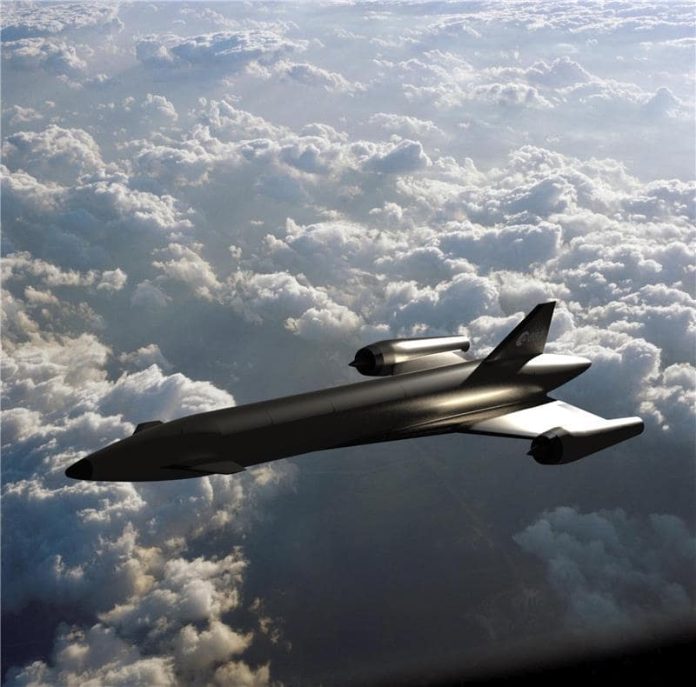
The European Space Agency (ESA) and UK-based Frazer-Nash have launched INVICTUS, a research programme aimed at developing hypersonic flight technologies suitable for future reusable vehicles capable of horizontal launch.
The vehicle will demonstrate key technologies for sustained hypersonic flight in the atmosphere and will be upgradable, allowing for the exchange of materials, software and propulsion systems between flight test campaigns.
INVICTUS is funded through ESA’s General Support Technology Programme (GSTP) and Technology Development Element (TDE) and is a fully reusable experimental aerospace vehicle capable of flying at Mach 5 (five times the speed of sound).
Hypersonic technology testing opportunities and challenges
INVICTUS builds on previous technology developments managed by ESA and will offer industry, agencies and academia an opportunity to test future hypersonic flight technologies in a relevant environment.
One of the main challenges of operating a hypersonic vehicle is that the outer surface of the aircraft and the air entering the engines become extremely hot at high speeds, due to shock heating and surface friction.
These conditions require specialised technologies, as well as unique propulsion systems, to power the vehicle through high-speed ranges.
David Perigo, ESA’s chemical propulsion engineer and the programme’s technical lead, explained: “The INVICTUS programme will prove the suitability of a hydrogen-fuelled precooled air-breathing propulsion system for horizontal take-off and hypersonic flight.
“It will provide an invaluable opportunity to test the complete engine flow path, from intake to afterburner, at full scale in an integrated aircraft.”
Precooler system paves the way for widespread access to space
The precooler system, built upon technology developed through ESA’s SABRE study, was designed by UK-based Reaction Engines Ltd. and funded through ESA’s GSTP in its initial stages.
This innovative technology, capable of chilling superheated air in a fraction of a second, has already been successfully demonstrated through integration with conventional jet engines.
In addition to providing a cooling system, the lightweight architecture of a SABRE-like engine paves the way for true spaceplanes, which can take off horizontally from a runway, bringing us a step closer to widespread access to space.
“INVICTUS is an exciting opportunity to provide advanced technology for space and realise dual-use capabilities,” stated Sarah Wilkes, Managing Director at Frazer-Nash.
“With strong industry support and deep engineering and aerospace expertise, we have all the right ingredients to make this ambitious vision a reality.”
The future of hypersonic flight
Over the next 12 months, the INVICTUS consortium, led by Frazer-Nash and including Spirit AeroSystems and Cranfield University, will deliver the preliminary design of the full hypersonic flight system.
Tommaso Ghidini, Head of ESA’s Mechanical Department, said: “By mastering reusable, air-breathing propulsion, we are laying the foundation for aircraft that take off like planes and reach orbit like rockets, revolutionising both terrestrial and orbital transportation. This is where dual-use innovation meets strategic autonomy.”
Hypersonic flight is not just the next frontier of aerospace – it is the gateway to a new paradigm of mobility, defence, and space access.
With INVICTUS, Europe is seizing the opportunity to lead in technologies that will redefine how we move across the planet and reach beyond it.