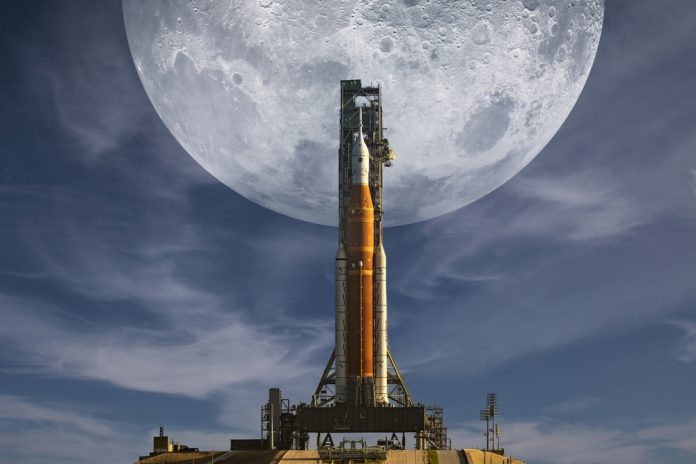
NASA has announced plans to launch Artemis II, the first crewed mission of its Artemis programme, no earlier than February 2026.
This mission will send four astronauts on a 10-day journey around the Moon, marking the first time in more than 50 years that humans will travel beyond low Earth orbit.
Building on the success of the uncrewed Artemis I flight in 2022, Artemis II will test critical systems aboard NASA’s Orion spacecraft and the Space Launch System (SLS) rocket, paving the way for future missions that will land astronauts on the lunar surface and eventually establish a permanent presence there.
The crew taking humanity further
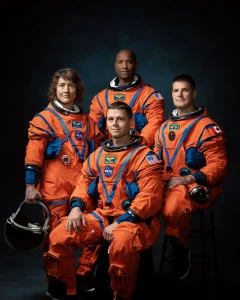
The Artemis II crew is composed of three NASA astronauts and one Canadian Space Agency astronaut, highlighting international cooperation in deep space exploration. The team includes:
- Reid Wiseman, mission commander and veteran NASA astronaut.
- Victor Glover, pilot and the first person of colour to participate in a lunar mission.
- Christina Koch, who will become the first woman to travel beyond low Earth orbit.
- Jeremy Hansen, the first Canadian to venture toward the Moon.
Together, this diverse crew will test spacecraft systems, conduct demonstrations, and provide crucial data for future lunar landings.
What makes Artemis II different?
Unlike Apollo missions of the past, Artemis II won’t land on the Moon. Instead, it will serve as a comprehensive systems check for the Orion spacecraft in the harsh environment of deep space.
The astronauts will confirm that life support, communication, and navigation systems perform as expected before NASA commits to landing crews on the lunar surface during Artemis III.
A key focus will be on Orion’s life support systems, which must generate breathable air, regulate carbon dioxide, and handle the metabolic demands of astronauts during exercise, work, and rest periods.
The mission will also test radiation shielding and evaluate emergency procedures for long-duration deep space travel.
How Artemis II will reach the Moon
The mission will begin at NASA’s Kennedy Space Center in Florida, where the SLS rocket will launch Orion into an elliptical Earth orbit.
After two loops around Earth to validate systems, Orion will fire its engines for a translunar injection, setting it on a four-day course to the Moon.
Instead of entering lunar orbit, Orion will execute a free return trajectory. This path utilises the gravitational forces of the Earth and Moon to swing the spacecraft around the lunar far side, sending the crew some 4,700 miles beyond the Moon, before gravity naturally pulls them back toward Earth.
This ‘gravity assist’ approach not only conserves fuel but also ensures a safe return should systems encounter issues.
Testing for future Moon missions
Artemis II isn’t just about reaching the Moon; it’s about preparing for everything that comes after. During the mission, astronauts will:
- Test manual flight operations, piloting Orion in proximity to the spent upper stage to simulate future docking manoeuvres.
- Evaluate communication systems, switching between NASA’s Deep Space Network and near-Earth satellite systems.
- Practice emergency drills to prepare for unexpected contingencies during future lunar landings.
These operations will provide engineers and mission planners with invaluable experience to support Artemis III, which aims to land astronauts on the Moon’s surface later in the decade.
Why Artemis II matters
The Artemis programme is more than a return to the Moon; it’s a stepping stone to Mars. By testing spacecraft, life support, and operational strategies in deep space, NASA hopes to build the foundation for longer missions to destinations farther away.
The mission also carries symbolic weight. For the first time, the crew includes a woman, a person of colour, and an international partner – underscoring NASA’s commitment to diversity and collaboration in shaping the future of space exploration.
Looking toward Artemis III and beyond
If successful, Artemis II will clear the path for Artemis III, which plans to land astronauts near the lunar South Pole – a region rich in resources like water ice that could support future lunar bases.
For more than half a century, the Moon has stood as a distant reminder of humanity’s boldest adventure.
With Artemis II, NASA and its partners are preparing to close that gap once again, proving that exploration is not just about reaching new places – it’s about building the future of human spaceflight.
If all goes according to plan in February 2026, Reid Wiseman, Victor Glover, Christina Koch, and Jeremy Hansen will write the next chapter of lunar exploration.
Their journey around the Moon will not only test spacecraft and systems but also rekindle the spirit of discovery that has driven humanity to explore the cosmos for generations.