SPACE4Cities pre-commercial procurement creates replicable solutions for better city management via smart use of European satellite data.
The SPACE4Cities innovation project, funded by the European Union’s Horizon Europe innovation programme via the European Union Agency for the Space Programme (EUSPA), aims to harness European satellite data to solve urban challenges and create more sustainable urban environments.
The method of public procurement utilised in SPACE4Cities project is called Pre-Commercial Procurement (PCP). Pre-Commercial Procurement is a useful method for public sector procurers to buy R&D services from several contractors (suppliers) in parallel, to steer development of innovative solutions not yet present in the market to meet public procurers’ needs, and to test developed solutions in real-life conditions for an extended period of time. In SPACE4Cities, we concretely aim to procure replicable solutions, via smart use of European satellite data, for better and more dynamic management of public space, green areas, transport infrastructure and city maintenance – and the cities’ overall resilience.
From concept to prototype
In November 2025, as part of the second Phase of the Pre-Commercial Procurement, SPACE4Cities selected ten companies utilising space technology to develop their concepts into working prototypes. The winning concepts will receive a total of €900,000 in funding.
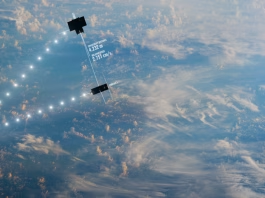
Traditionally, satellite data has been used for monitoring weather or disasters, for navigation and surveillance, for defence and intelligence. Now, the SPACE4Cities project is exploring new horizons by investigating how space technologies could benefit European cities in preparing for climate change.
The ten winning concepts selected by SPACE4Cities are developing space technology solutions for common challenges in European cities, such as detecting floods and heat islands, reducing traffic emissions, preventing wildfire risks, protecting cultural heritage sites, tracing underground pipe leaks, and monitoring the condition and changes of green spaces, bridges, and roads.
“We are extremely pleased with the innovativeness of the winning solutions in this Prototyping Phase. We believe that many of them will be in use in cities around Europe in the near future. There is a lot of potential for efficiency gains and cost savings,” said the Project Coordinator, Renske Martijnse-Hartikka from the City of Helsinki innovation company, Forum Virium Helsinki.
Benefits for municipalities around Europe
The benefits are wide and vary per solution. Some of the companies develop comprehensive tools for European cities to proactively address critical climate risks and adapt or optimise planning related to, for example, wildfires, urban heat, flooding, biodiversity or urban greening. Another benefit useful for a wide variety of municipalities is the enhancement of infrastructure integrity and efficiency through predictive maintenance. Various solutions use satellite techniques to detect millimetric ground and infrastructure stress. This continuous, non-intrusive monitoring reduces maintenance costs, prevents failures, and ensures resilient public services. Finally, some of the solutions can aid cities in achieving sustainable development and climate neutrality goals through data-driven governance. Their highly innovative monitoring tools provide the verifiable data needed for cities to measure impact, improve public health, and ensure sustainable urban development.
Real-life pilots after summer
In July 2026, the five best prototypes – out of the current ten – will be awarded with development funding of a total of €1,250,000. They also have the opportunity to pilot in real-life situations in 15 European cities: Amsterdam, Athens, Ghent, Guimarães and Helsinki, as well as ten so-called Replicator Cities. A Call for such Replicator Cities will be launched in late spring 2026. The benefits for them include a free three-month solution pilot and favourable commercial terms to sustain the solutions beyond the pilot, a small budget to cover pilot-related travel or engagement expenses, and peer-to-peer knowledge exchange with the SPACE4Cities Buyer Group cities throughout the pilot phase. After the piloting phase has ended, in spring 2027, the solutions are made ready for wider commercialisation and follow-up procurements are planned.
Top ten companies and their solutions
Six of the current ten winners are individual companies, while four consist of a consortium of multiple companies. The companies come from France, Spain, Italy, Portugal, Belgium, Germany, and the Netherlands. This is the list of ten solutions and suppliers in the prototyping phase of the SPACE4Cities Pre-Commercial Procurement:
- AI-WUIFIRE: Prevention of wildfire risks – Vexiza (Spain)
- CHERISH: Protection of cultural heritage sites – eOnsight (France)
- CityMotion: AI agents for urban stability and infrastructure – Detektia (Spain)
- CLIMAPS: Detection of heat islands, floods, and extreme weather events – Latitudo 40, Planetek and Teamdev (Italy)
- DYNAMO-SM: Traffic emission reductions – Everimpact (France)
- GeoRisk Monitor: Monitoring of the condition of bridges, roads, and railways – Survintel (Netherlands) and Gisaia (France)
- OPTIM-Green: Strategic planning of urban green spaces – Optim.aize (France)
- URBAN LENS: Tracing of underground pipe leaks – Neptune and Cosmic (Italy)
- UrbanRoots: Monitoring the condition and changes of green spaces – CEiiA (Portugal)
- VISTA: Management of green areas and biodiversity – BitaGreen (Belgium), Climate Scale (Spain) and TreeSense (Germany)
Procuring partners and expert organisations collaborate
The SPACE4Cities project is implemented by the City of Helsinki innovation company Forum Virium Helsinki (Finland), City of Amsterdam (Netherlands), Municipality of Guimarães (Portugal), the Regional Development Fund of Attica (Greece), the City of Ghent’s digital innovation and technology organisation District09 (Belgium), Open & Agile Smart Cities network (OASC), and Europe’s leading aerospace cluster Aerospace Valley (France).
Please note, this article will also appear in our Space Special Focus publication.