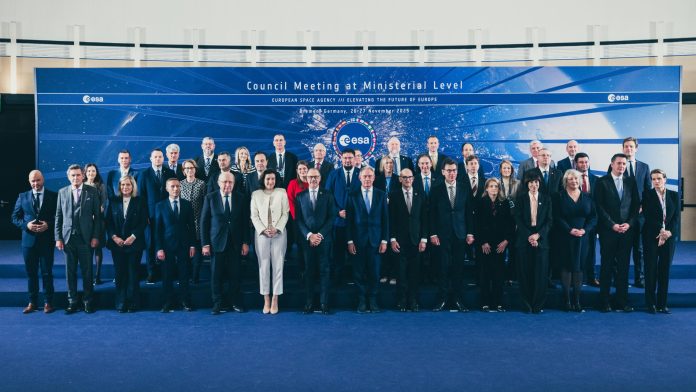
The UK space industry is set for a decade of accelerated growth, innovation and security resilience after the UK Government confirmed a £1.7bn funding package for European Space Agency (ESA) programmes.
The deal, finalised at the ESA Council of Ministers (CM25) in Bremen, marks one of the UK’s most significant strategic investments in space to date.
Commenting on the funding, UK Space Minister Liz Lloyd CBE said: “Our space sector is a key driver of our economic growth and national security, and also supports our allies in Europe and beyond.
“After these negotiations in Bremen, during what remains a challenging time for economies across Europe, we have secured backing for our priority ESA programmes, which will support thousands of jobs, greater resilience and cutting-edge science and technology across the UK.”
A long-term commitment to growth and security
The latest package brings the UK’s total commitment to ESA initiatives to £2.8bn over the next decade, spanning from 2025/26 through 2034/35.
Additional commitments are expected at the next ESA Council meeting in 2028, signalling a sustained long-term strategy.
This funding is designed to generate maximum value for taxpayers while securing the UK’s role in a fast-expanding global market.
Each pound invested in ESA is estimated to return £7.49 in direct economic benefit, helping sustain thousands of high-skilled jobs and stimulating innovation across industry and academia.
Strengthening UK access to space
A standout element of the new programme is a record £162m investment in launch capabilities, including support for the European Launcher Challenge.
The goal is to open Europe’s launch market to more commercial providers, reducing costs, improving resilience and ensuring satellite access for critical services such as communications, navigation and weather forecasting.
The UK Government says enhanced launch capability is now a national security priority. By working with NATO partners and European allies, Britain aims to secure assured, independent access to space in an increasingly unpredictable global landscape.
Backing flagship scientific missions
Two high-profile missions led or strongly backed by the UK space industry received fresh momentum at the Bremen meeting.
Vigil: Protecting Earth from solar storms
The UK-led Vigil mission, designed to monitor disruptive solar activity, secured £131m in new funding.
In partnership with the United States and supported by European collaborators, Vigil will track space weather from a unique vantage point ahead of Earth.
Extreme solar storms can damage power grids, aviation systems and satellite networks.
With sightings of the Northern Lights recently visible across the UK due to solar activity, the mission underscores the growing importance of protecting critical infrastructure.
Rosalind Franklin Mars rover moves toward 2028 launch
Britain’s flagship contribution to planetary exploration – the Rosalind Franklin Mars rover – also gained renewed backing.
Built in the UK and central to Europe’s first Mars rover mission, its 2028 launch window is now closer to reality. The rover aims to search for signs of ancient life beneath the Martian surface, keeping the UK at the forefront of global space science.
The UK space industry will also maintain its involvement in the Argonaut lunar lander, following newly awarded contracts to British companies supplying engines and propulsion systems.
Driving innovation and commercialisation
To accelerate emerging technologies, the government has allocated £261m to high-growth programmes such as the Commercialisation, Advanced Research in Telecommunications Systems and the General Technology Support Programme.
Among the most transformative initiatives is support for a direct-to-device satellite system capable of connecting standard mobile phones – boosting emergency resilience and providing connectivity in remote regions.
A further £57m will advance UK capabilities in Position, Navigation and Timing (PNT) systems, essential for transport, defence, financial trading and smart infrastructure.
Investing in science and Earth observation
The UK confirmed £511m for ESA’s core science budget, ensuring British researchers remain central to breakthrough astrophysics and planetary missions.
In addition, a £120m ministerial commitment for Earth observation will enable new mission studies and strengthen the UK’s ability to use climate and environmental data.
With earlier pledges included, the UK now plans to invest around £350m in ESA Earth observation programmes over the next four years.
A rapidly expanding space sector
The UK space industry already supports 55,000 jobs, with an additional 81,000 roles across its supply chain, generating £18.9bn in annual income.
Satellite-enabled services underpin an estimated 18% of the UK’s GDP, highlighting the deep integration of space technology across national infrastructure.
This new ESA package forms a core part of a wider £2.8bn government investment in national civil space priorities through the UK Space Agency, announced earlier this year.
Together, these measures pave the way for a stronger, more competitive and more secure space future for the UK.