PITHIA-NRF integration project provides access to research facilities, to data collections and scientific models and to all possible tools required by the research community for enhanced understanding and modelling of the physical mechanisms underpinning the interconnected regions of the Earth’s plasmasphere, thermosphere and ionosphere.
PITHIA-NRF (Plasmasphere Ionosphere Thermosphere Integrated Research Environment and Access services: a Network of Research Facilities) is the European Research Infrastructure that aims at facilitating research and development in the domain of the Upper Atmosphere and near-Earth space environment. PITHIA-NRF provides researchers access to a testbed for experimentation with data and for the development of validation of new scientific models that can be transformed, as a future step, to operations, useful for services dedicated to space weather monitoring and forecasting and to Space Situational Awareness.
Key innovations of PITHIA-NRF
1. Integrated European research infrastructure
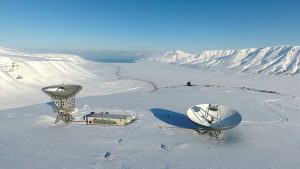
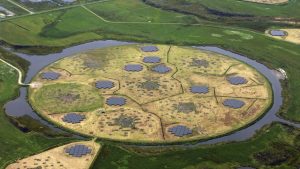
PITHIA-NRF establishes a comprehensive European network of experimental facilities – the PITHIA-NRF nodes – by integrating national and regional research infrastructures, including facilities like EISCAT, LOFAR, Ionosondes, Digisondes, GNSS receivers, Doppler sounding systems, riometers, and VLF receivers. This integration facilitates coordinated observations and data sharing across Europe, advancing the study of the ionosphere, thermosphere, and plasmasphere.
2. Open access to data and tools
The project provides open access to data, and scientific models. Through the PITHIA-NRF e-Science Centre (eSC), researchers can access FAIR (Findable, Accessible, Interoperable, Reusable) data, standardised data products, a suite of data processing, prediction tools, and workflows, promoting collaborative research and innovation.
3. Standardisation and interoperability
PITHIA-NRF emphasises the development of standards for data interoperability, including data models and domain ontologies. This standardisation ensures that data and tools from various sources can be seamlessly integrated and utilised across different research platforms.
4. Transnational access (TNA) programme
The project offers a Transnational Access programme that subsidises external researchers to utilise PITHIA-NRF nodes. This initiative supports hands-on and remote projects, enabling researchers to conduct experiments, collect data, and analyse results using the project’s tools and services provided by the nodes and by the eSC.
5. Comprehensive training and capacity building
PITHIA-NRF provides organised and systematic training through workshops, schools, webinars, and on-site sessions. These training programmes are designed for project partners, students, scientists from countries with limited space research infrastructure, and engineers from private companies, fostering a skilled community in upper atmosphere research and near-Earth space science.
6. Integration with European Open Science Cloud (EOSC)
By connecting with the EOSC, PITHIA-NRF ensures long-term preservation and accessibility of observational data. This integration supports the advancement of knowledge in ionospheric, thermospheric, and plasmaspheric research domains, especially regarding long-term studies.
Impact and future prospects
PITHIA-NRF’s innovative approach in integrating diverse research infrastructures, standardising data and tools, and promoting open access significantly enhances the capabilities of the scientific community to study and understand the upper atmosphere and the near-Earth space environment.
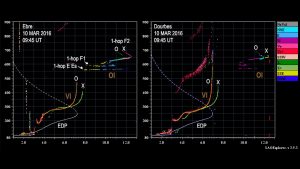
By facilitating collaborative research and providing comprehensive training, the project not only advances current scientific knowledge but also lays the groundwork for future innovations in space weather research and related technologies. TNA projects implemented in PITHIA-NRF nodes demonstrated research advances in multi-instrument data analysis, in the development and validation of scientific models, in ionosphere–interplanetary medium imaging methods, and in the calibration of new instruments (more details to be found in the article published by Belehaki et al. (2025) in Advances in Space Research.¹
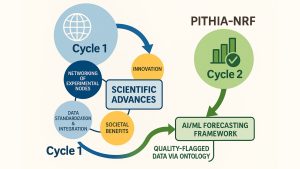
Based on these successful developments, PITHIA-NRF has the potential for enormous impact on structuring the scientific community, producing innovation, providing societal benefits, and influencing future governance and funding decisions. The main achievement that drives all impacts comes from scientific advances.
However, a key additional benefit, especially for the operations domain, is the possibility provided by the PITHIA-NRF ontology to characterise data products with quality flags. This could meet the requirements of the Space Safety and Security Programme of the European Space Agency and of the European Union Space Programme, who need data with controllable quality, a very complex procedure that requires cleaning, curation, transformation and integration among other workflows and it is planned to be achieved by the PITHIA-NRF community in a follow-up project. Such development, together with the availability of tools to retrieve massively archived data, would extremely support future AI/ML modelling developments where the use of clean data and the availability of archived data are instrumental for the reliability of the models’ performance and the retraining process.
The establishment of an AI/ML modelling framework is the next major goal for the PITHIA-NRF community to address the critical requirement for real-time forecasts with specified accuracy regarding ionospheric disturbances and irregularities, atmospheric drag effects and the plasmasphere dynamics depending on geomagnetic activity.
References
- https://doi.org/10.1016/j.asr.2024.11.065